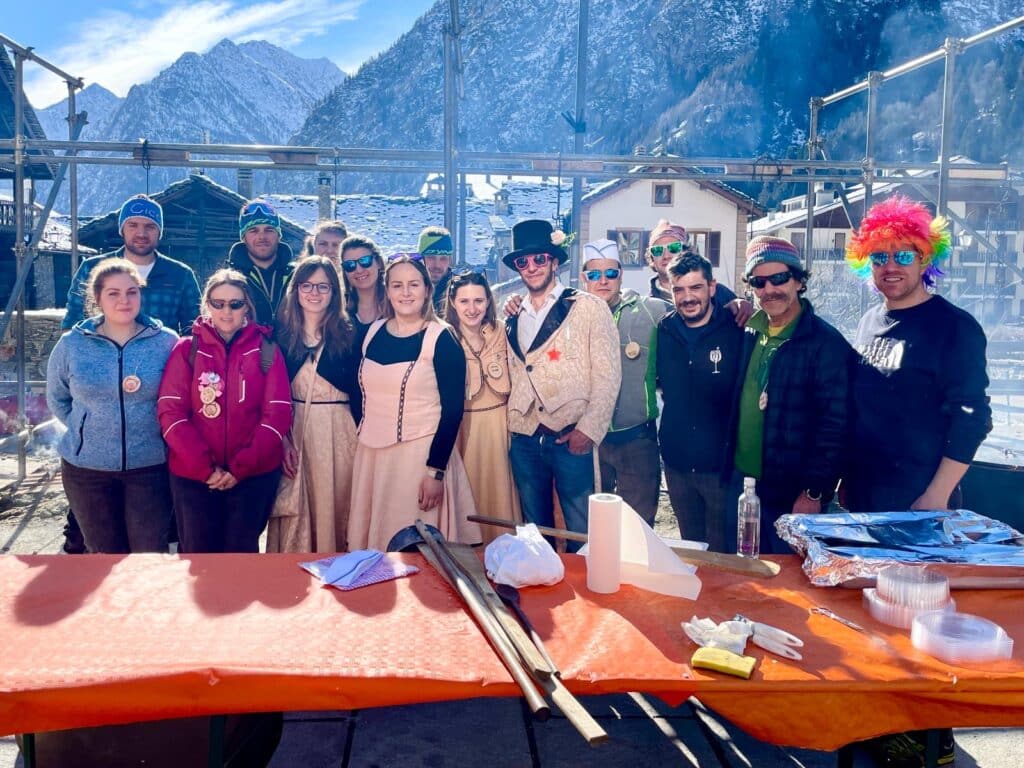



The Alagna Carnival is one of the most authentic traditions of Alagna Valsesia.
Over time, its origins have been preserved through the collective memory of the community and passed down orally from generation to generation.
Although no written sources precisely document its beginnings, this popular dimension makes the Carnival a living expression of local cultural heritage.
Among the most recognizable symbols, the Carnival features Schwi and Schwilja, the pig and the sow.
Created in the 1990s, these masks quickly became iconic figures of the celebration.
Thanks to their first performers, Ivana Valzer and Gianpaolo Orso, the characters gained identity and meaning.
As a result, they now embody the ironic and communal spirit of the Alagna Carnival.

The most representative culinary tradition of the Carnival is Paniccia, a typical Carnival dish. The earliest documented accounts date back to 1959, when a group of residents of Alagna decided to prepare it for the first time on Shrove Tuesday, inspired by the traditions of neighboring villages in Valsesia.
Before the distribution of Paniccia, it was customary to hold the piglet race along the village’s main street—a festive moment involving children, musicians, and residents, with the piglet adorned with a colorful wreath around its neck.
On the morning of Shrove Tuesday, the main square came alive with traditional folk games, including the greasy pole, a symbol of skill and collective fun. As evening fell, small bonfires known as “faschnachtfirljini” were lit in every hamlet, accompanied by the ritual shouts of “Huru”, echoing from one part of the village to another.
The day concluded with the masked ball at the Unione Alagnese, renowned for its elaborate and sometimes unsettling masks, a distinctive feature of the local Carnival.
Today, the Alagna Carnival officially begins on Epiphany Day, with the first ball held at the Unione Alagnese. On this occasion, the Mayor symbolically hands over the wooden keys to the main masks, marking the official opening of the celebrations.
In the days leading up to Shrove Tuesday, the following events take place:
The day ends with the Ball of the “Popolo Porco”, renewing the bond between the community and its traditions.
The deep connection between the Carnival and the identity of Alagna is also evident in the Theatre of Alagna Valsesia, inaugurated in 1900, where the emblem of the pig decorates the front of the stage.
A traditional legend from Valsesia tells of a symbolic rivalry between the Purcei of Alagna, the Garuf of Riva Valdobbia, and the Brusoign of Mollia—a story passed down orally that continues to enhance the Carnival’s charm. Today, besides Alagna, only Campertogno still preserves the tradition of Carnival masks.
The Alagna Carnival is not just a celebration, but an intangible cultural heritage, an expression of identity, memory, and collective participation. A tradition that continues to evolve while preserving its deep meaning in the heart of Valsesia.