


There is a valley that the people of Alagna carry in their hearts more than any other. Not the highest, not the most famous — yet one that, once seen, is hard to forget. It is Val d'Otro: a lush green basin, inhabited for centuries, dotted with stone and larch hamlets bearing names that still sound exactly as the Walser people once pronounced them.
The trail that leads there — trail 203 — starts from the centre of Alagna and climbs through forests, ancient terraced fields and sudden, breathtaking views. This guide takes you through every stage of the journey.
The trek to Val d'Otro begins in the village, in front of the Teatro Unione Alagnese: one of the historic theatres of Valsesia, built in the early twentieth century and perfectly preserved. One hundred and twenty-six years of history, carried quietly — as everything in Alagna tends to be.
It's a detail worth pausing on before you set off: Walser culture expressed itself not only in the stone of mountain huts and terraced fields, but also in spaces for gathering and shared life, like this one.
Shortly after the start, passing through the hamlet of Reale di Sopra, you come across a house with a fresco on its façade depicting the Madonna and Child. Grace and craftsmanship, from people who lived by farming and livestock keeping — at altitude, with limited means and a long winter ahead.
It is one of the many quiet gestures of beauty that this trail offers: beauty as an everyday act, not an exception.
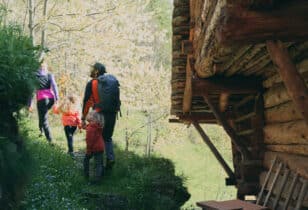
Once you join trail 203 — clearly signposted — the stone steps set the rhythm: breath needs to be paced, steps become deliberate. After roughly ten minutes of walking, the first viewpoint opens up.
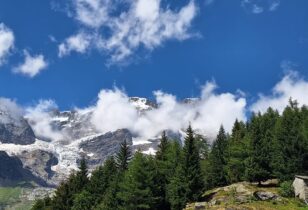
A wooden sign marks Der Spiegel — "the mirror" in German. Through the gap in the trees, the whole of Alagna is visible below: the village in the valley floor, Monte Rosa in the background, hamlets scattered across the slopes. The name is perfectly chosen: the landscape offers itself like a reflection, clear and complete.
Further along, the trail passes through clearings where mountain huts alternate with the remains of terraced fields once used for cultivation. Every corner carries the signs of patient, determined work: dry-stone walls, steps carved into the mountainside, land claimed from rock with extraordinary effort.
The Walser were tireless workers, accustomed to altitude and harsh weather — but they were also craftspeople, painters and sculptors. You see it everywhere, if you look carefully enough.
Around the halfway point of the trail, you come across a stone fountain carved with a series of unusual marks. These are not random decorations: they are the Huszaiche, the identifying symbols of the historic family lines of Alagna.
Each family had its own sign, passed down through generations. You find them carved into the doorframes of old houses, but also on everyday objects — household items, work tools, dowry chests. A silent signature that crosses centuries.
A little further on, the path leads to the Sasso della Madonna: a rock on which, according to local tradition, the hand of the Blessed Virgin is imprinted. It is one of those places where landscape and devotion overlap naturally, without contrivance — as often happens in Walser territory, where faith is rooted in the land itself before it is ever built into a church.
Beyond the rock, the trail continues upward through forests of conifers and beech trees. Walk quietly and you stand a good chance of spotting squirrels darting between the trunks in search of spruce cone seeds — a favourite food. You recognise them by their full, bushy tail, which serves as both parachute and balancing pole, and by their sudden, acrobatic movements. The acrobats of the forest, as they are known in the valley.
At the edge of the treeline, the valley opens without warning: the Val d'Otro basin appears, with its larch houses arranged across the slopes, the small church of the Madonna della Neve at its centre and, in the distance, the ridgelines that lead even higher.
The Madonna della Neve is celebrated by the hamlet communities every year on 5 August: a tradition that has marked the valley's summer for centuries.
The hamlet names were never Italianised. They remain exactly as the Walser used them, and precisely for this reason they have passed into common use without needing translation.
Feljeretsch — the easternmost hamlet. It once housed an inn, which has since been brought back to life as a guesthouse.
Follu — the name means "milk strainer", most likely because the old dairy was located here; it has since been converted into a mountain hut.
Fum Tschukke — "On the rock": the hamlet is built directly on the bedrock, from which it looks out over the entire valley. (Passing through the hamlet you can reach the Belvedere viewpoint, which offers the finest panorama over Alagna.)
Dorf — its houses all face south, in perfect alignment with modern principles of passive solar design — anticipated by several centuries. At the entrance to the hamlet stands the bread oven, restored and still fully in use.
Zar Skorpiu — the last hamlet on the main route. The houses bear carved construction dates: 1564, 1594, 1661. The oven here too is used for the traditional Festa del Pane (Bread Festival), organised by the hamlet community.
Weng — "on the slopes": situated along the trail connecting Scarpia to D'Sender on the loop route 203 A. The fields around it are still cultivated, which gives the hamlet an air of life — present, not merely preserved.
In the basin, Rifugio Zar Senni is the natural rest point of the route. The tireless Ivana prepares game and mountain dishes with the same care that has always defined the cooking of these hamlets. If the aromas reach you from a distance as you descend, that's reason enough not to hurry.
Details and bookings: alagna.it/ristoranti/zar-senni-otro
Passing through the lanes of Fum Tschukke, a short detour leads to the Belvedere: the point from which the widest and most complete view over Alagna and the valley floor opens up. Well worth the extra few minutes.
Trail 203 and its loop variant 203 A are just the entry point to Val d'Otro. The valley continues northward, towards progressively higher alpine pastures, mountain passes and connections to neighbouring valleys. Those who wish can build their own route — following curiosity, available elevation, or simply whichever direction feels right.
How do you get to Val d'Otro? The route starts from the centre of Alagna Valsesia, in front of the Teatro Unione Alagnese. Follow trail 203, which is clearly signposted, up to the Val d'Otro basin.
How long is trail 203 to Val d'Otro? The one-way walk from the village to the basin takes approximately one and a half hours. The loop route 203 A allows you to return via additional hamlets.
What are the Huszaiche? They are the identifying symbols of the historic Walser family lines of Alagna. Found carved on fountains, doorframes and everyday objects, they represent one of the oldest forms of family identity in Walser culture.
Is there a mountain hut open in Val d'Otro? Yes, Rifugio Zar Senni is located in the Val d'Otro basin and serves meals including mountain dishes and game. It is advisable to check opening periods on the Alagna website.
When is the Festa del Pane (Bread Festival) held at Zar Skorpiu? The date varies each year and is organised by the Val d'Otro hamlet community. Contact the Alagna Tourist Office for the current date: +39 0163 922 988.
When is the Madonna della Neve celebrated in Val d'Otro? The Madonna della Neve feast is celebrated every year on 5 August.