


There is a precise moment when Valle Vogna captures you: in late spring, when dandelions cover the meadows, cherry trees blossom along the paths and crocuses push through the edges of pastures still damp with snowmelt. Time and space seem to pause. It's not a figure of speech — it's what actually happens when you walk here.
Valle Vogna is ancient land. It was settled in the early fourteenth century by Walser Alemannic colonists arriving from Gressoney — and the valley's very name appears to derive from Wohna, meaning "inhabited valley" in Germanic. A land of passages, merchants and migrants, of families who survived plague, fires, avalanches and the long weight of winter.
This itinerary is part of the Valsesia Art Trails (Sentieri dell'Arte Valsesiani): a name that says it all, because here landscape and art are woven together at every bend in the path — in votive chapels, painted sundials and granaries raised on stone columns.
The route begins at the Ca d'Janzo car park. From here the trail climbs towards the upper hamlets of Valle Vogna, passing through pastures, forests and terraced fields that speak of centuries of work and life at altitude.
The first stop is Selveglio, at 1,536 metres above sea level. The name may derive from Silvelius — forest — and the area is thought to have been inhabited since pre-Roman times. By the late seventeenth century, more than a hundred people lived here.
Selveglio was the birthplace of a remarkable figure: Abbot Antonio Carestia, the celebrated nineteenth-century Valsesian botanist and scholar of alpine flora and local traditions.
At the entrance to the hamlet, a small chapel dedicated to the Madonna del Carmine welcomes visitors beside the large stone fountain. Immediately noticeable is a fine sundial — not a decorative afterthought. In these communities it was common practice to mark the passage of time by following the sun: its rising, its setting, its angle in the sky. A way of measuring time rooted in landscape long before calendars arrived.
Continuing towards the hamlet of Oro, the trail leads to another small chapel: it was built by local inhabitants as a votive offering, in gratitude for surviving the plague of 1630 — the same epidemic that devastated much of northern Italy and left deep marks throughout Valsesia.
On the façade are three sundials painted in the nineteenth century, distinguished by an unusual feature: they include representations of the signs of the zodiac. A detail that surprises, in these lands of faith and hard work — and a reminder of how richly layered Walser culture could be.
The hamlet of Oro still bears the marks of a fire in 1913 that destroyed much of it — a fate shared by many alpine hamlets built predominantly in wood.
Dominating the settlement stands a Stodal: an ancient granary raised on wooden columns, with characteristic mushroom-shaped stones at the base — an ingenious system to prevent rodents from climbing up and reaching the food stores. It is a near-unique feature in this area, and one of the most photographed sights along the entire route.
Also worth a stop is the oratory of San Lorenzo, built in 1706 by the heads of local families: a place where they could receive Communion without having to descend to the valley — impossible in certain seasons or weather conditions. A practical solution that reveals, once again, the Walser capacity to build self-sufficiency wherever the mountain imposed isolation.
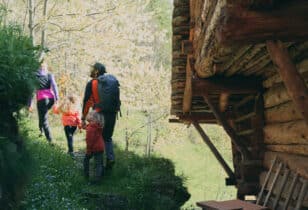
Ca Vescovo is one of the most evocative hamlets on the route: the houses are old, and the timber makes that clear — beams that have held the weight of decades of winters, walls that have sheltered generations. There is no over-restoration here: time has left its marks, and the hamlet is more beautiful for it.
Rabernardo is one of the largest hamlets on the itinerary. It has three fountains, three bread ovens still recognisable in the stonework, and a small chapel dedicated to the Madonna della Neve.
Historical documents reveal a curious detail: the hamlet once housed a workshop where locks and jaw harps were made — the instrument known in Italian as Ribeba or Marranzano. Specialised craftsmanship, in such a remote location, that shows how far the Walser communities were from being cut off from the wider world.
The private house of the Locca family, dated 1640, has since been converted into an Ethnographic Museum: a chance to step genuinely inside the everyday life of these hamlets.
Cambiaveto is a recently restored hamlet perched on the edge of a gully. It stands out for a specific architectural feature: a building with a three-pitched roof, characteristic of Valle Vogna and unusual elsewhere. A technical detail that has become an identifying mark.
Piane consists of two separate clusters of houses. Protecting them is a stone avalanche barrier with the date 1560 carved into it — one of the oldest alpine protection structures in the area, still standing, still serving its purpose.
All around, pastures and fields remain in active use. The hamlet is permanently inhabited year-round: here the rhythm is still set by the cockerel's crow, the slow snowy days of winter, the first warmth of spring. A journey through time that requires no ticket.
The final stop on the itinerary is Peccia — the local dialect name for the Norway Spruce, the conifer typical of the area. It is among the oldest inhabited settlements in Valle Vogna, and its history is layered.
Its people survived the plague of 1630 and the passage of Napoleonic troops in the early nineteenth century. The houses withstood fires and avalanches — and local oral tradition holds that one particularly violent avalanche moved an entire house, with its inhabitants inside, depositing it further down the slope without harming anyone. A story that sounds like legend, yet is kept alive in the valley's collective memory.
To the south of the hamlet stands the small chapel dedicated to San Nicolao, a saint held particularly dear in Walser tradition. To the north, closing around the hamlet in an almost protective embrace, the oratory of San Grato: one of the oldest religious buildings on the entire route.
Descending back towards Ca d'Janzo, the trail passes a small lake with emerald-green water: one of those places you don't expect, and that stops you precisely because of it. The local council has set up the area with wooden picnic tables — the perfect spot for a meal with a view before returning to the car.
Where does the Valle Vogna trek start? The route starts from the Ca d'Janzo car park in Valle Vogna. From there, the trail climbs towards the upper hamlets: Selveglio, Oro, Ca Vescovo, Rabernardo, Cambiaveto, Piane and Peccia.
What are the Valsesia Art Trails? They are themed itineraries that combine natural landscape with artistic and religious heritage: votive chapels, sundials, oratories and Walser architecture. Valle Vogna is one of the richest routes in the network.
What is a Stodal? It is an ancient alpine granary raised on wooden columns, with mushroom-shaped stones at the base to prevent rodents from reaching the food stores. The one at Oro is among the best-preserved examples in the area.
When is the best time to visit Valle Vogna? Late spring is the most spectacular time, with dandelions, cherry blossom, crocuses and bluebells in flower. The route is also enjoyable in summer and autumn.
Is there anywhere to eat along the route? The itinerary passes through hamlets with accommodation and catering (such as Feljeretsch), and there are picnic areas including the one at the emerald lake near Ca d'Janzo. For further information: Alagna Tourist Office, +39 0163 922 988.
Who was Abbot Carestia? Antonio Carestia (1825–1908) was a priest and botanist born in Selveglio, in Valle Vogna. He is considered one of the foremost scholars of Valsesian alpine flora and made a significant contribution to the scientific knowledge of the Italian Alps.