


Spring in Alagna Valsesia doesn't arrive all at once. It comes in layers: first the bright green of the valley hamlets, then the snow retreating up the slopes, then the roar of the Sesia swelling with snowmelt. It's in this transition between seasons that the valley catches its breath — and begins offering experiences that shift and change, month by month.
From the high-altitude huts reopening in late May to the livestock fair at the start of summer, this guide covers everything worth experiencing in Alagna between April and June.
With the ski lifts reopening at the end of May, the high-altitude huts become accessible again — marking, in many ways, the threshold between the quiet spring low season and the alpine summer.
Among the first huts to open is Capanna Gnifetti, nestled among the rocks at 3,647 metres above sea level. It's an essential stop for anyone heading towards the summit of Monte Rosa: the body adjusts to the altitude, breathing slows, and time takes on a different meaning.
The hut is famous for its orange sunsets — a sight that stays with you — but also for a level of comfort that feels almost surprising at that elevation: duvets, hot showers, and a menu that holds its own against any valley restaurant. And everything, without exception, is plastic free.
Less plastic, less waste, more respect for the glaciers just a few steps away. It's not just an aesthetic choice — it's a necessary one.
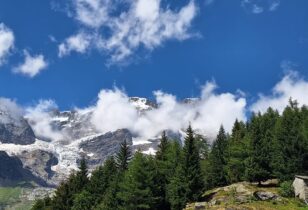
The glaciers of Monte Rosa are more than a landscape. They are a climate archive: each layer of ice holds a record of what happened in our atmosphere over the centuries.
This is why it's not unusual, in Alagna, to come across glacial coring expeditions by the CNR-ISP — the specialists who study ice deposits to reconstruct past climate changes and monitor those currently underway.
Working in the same spirit is the Carovana dei Ghiacci (Glacier Caravan) Project, which visits the valley every year with field monitoring sessions and public events, raising awareness about the decline of glaciers and the loss of alpine permafrost.
In Alagna, talking about water almost goes without saying: every hamlet has its own bubbling fountain, every mountain pasture its own spring. The quality is such that, in recent years, the use of reusable water bottles has been actively promoted, and taps dispensing Acqua Pura — known locally as "the Mayor's Water" — have been installed across bars and restaurants. The result? Thousands fewer plastic bottles every season.
The Sesia is the quintessential mountain river: crystal clear, rushing, fed by the snows of Monte Rosa. And in spring, it becomes the setting for one of the valley's oldest traditions: fishing.
The tourist fishing stretch officially opens on 25 April, marking the start of a season that draws enthusiasts from across Italy.
Fishing in Valsesia is regulated by the Società Valsesiana Pescatori Sportivi, which manages rivers, streams and alpine lakes to protect species and respect their natural cycles. It's not a free-for-all — it's a practice rooted in the conservation of the river ecosystem.
Anyone wanting to try it for just a day can purchase a day permit giving access to the Tourist Reserve. The maximum permitted catch is six trout: Brown Trout (max length 22 cm) or Rainbow Trout (max length 20 cm).
Full details and permits: valsesiapesca.it
The most common species in the Sesia is the Brown Trout (Salmo trutta fario), native to the cold, fast waters of the Alps. In the kitchen it lends itself to a range of preparations: marinated in vinegar and herbs, baked with potatoes, or served with polenta — the pairing the Walser people considered perfect. A simple, frugal cuisine, born from the hard work of farming and livestock keeping, where nothing was wasted and everything came from the mountain.
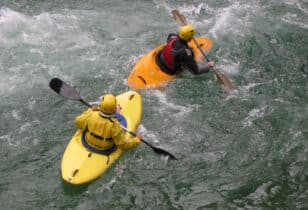
As the glaciers melt, the Sesia transforms: its waters charge with energy, the rapids grow more intense, and the call of the river becomes hard to resist. For the enthusiasts — affectionately known in the valley as the "umidi" (the wet ones) — the season starts in spring and doesn't wait for sunshine.
Rafting is practiced on inflatable rafts in teams of four or more. The descent is fast and exhilarating: life jacket, helmet and wetsuit are mandatory.
For those who prefer a solo experience, canoe and kayak offer a direct encounter with the current. It's just you, the paddle and your ability to read the water: a silent conversation between body and nature.
Canyoning combines river techniques with alpine climbing. Jumps, slides, abseils and rope descents — it's the ideal sport for those who carry their passion for rock onto the water. Equipment includes a wetsuit, helmet, rope, descender and harness. Always recommended with a qualified guide.
Full information on water sports in Alagna: alagna.it/esperienze/il-fiume-sesia
2 June is one of the dates historically associated with the Pietre Gemelle Fair, organised by the Municipality of Alagna-Riva in collaboration with the Unione Montana dei Comuni della Valsesia — though the exact date may vary from year to year. It's always worth checking with the local council before planning your visit.
This is no ordinary fair. It's a propitiatory rite for the summer season, the moment when the livestock is shown off before heading up to the high pastures.
The herds are brought to the sports fields area of Riva Valdobbia, known as "delle Pietre Gemelle". Days ahead, stalls, water troughs and hay supplies are set up. The animals arrive dressed for the occasion: best cowbells, flower crowns, the steady, unhurried pace of creatures that know how to be seen.
On show are the main alpine cattle breeds: Piemontese, Valdostana, Grigia Alpina, Pezzata d'Oropa and the Bruna Alpina — recently reintroduced for its remarkable adaptability to the steep terrain of high mountain farming.
Livestock fairs are traditionally held at the end of summer, around the feast of San Michele, when the herds return from the high pastures. Alagna's fair breaks with this: it takes place at the start of summer, as a kind of blessing for the season ahead. Almost a rite of passage.
Alongside the livestock, the event hosts farm businesses, wood artisans, cheese and charcuterie producers, food stalls and local craftspeople. A chance to step into the heart of Walser culture before summer takes full hold.
When do the high-altitude huts reopen in Alagna? High-altitude huts on the glacier, such as Capanna Gnifetti, generally reopen in late May, in line with the reopening of the ski lifts.
When does fishing season start on the Sesia in Alagna? The tourist fishing stretch opens on 25 April. A day permit purchased through the Società Valsesiana Pescatori Sportivi gives access to catch Brown Trout and Rainbow Trout.
What water sports can you do on the Sesia in spring? Rafting, canoe, kayak and canyoning. Spring is the best time, with high water levels and the most powerful rapids of the year.
What is the Pietre Gemelle Fair? It's a livestock fair held in early summer in Riva Valdobbia, featuring alpine cattle breeds, local produce and traditional crafts. Organised by the Municipality of Alagna-Riva and the Unione Montana dei Comuni della Valsesia. The exact date varies each year — check the municipal website for updates.
How can you visit the Monte Rosa glaciers? The glaciers are accessible by ski lift (from late May), with alpine guides, or by joining the programmes of the Carovana dei Ghiacci Project. Capanna Gnifetti, at 3,647 m, is the main logistical base on the glacier.