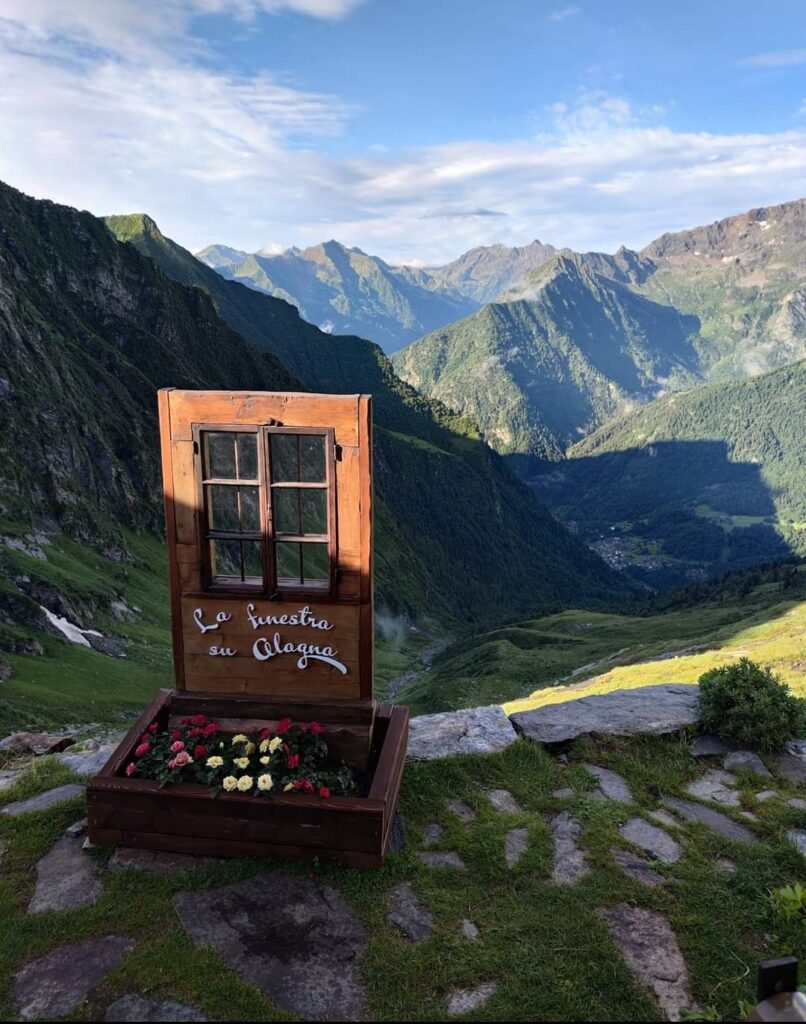



There is a precise moment when Valle Vogna captures you: in late spring, when dandelions cover the meadows, cherry trees blossom along the paths and crocuses push through the edges of pastures still damp with snowmelt. Time and space seem to pause. It's not a figure of speech — it's what actually happens when you walk here.
Valle Vogna is ancient land. It was settled in the early fourteenth century by Walser Alemannic colonists arriving from Gressoney — and the valley's very name appears to derive from Wohna, meaning "inhabited valley" in Germanic. A land of passages, merchants and migrants, of families who survived plague, fires, avalanches and the long weight of winter.
This itinerary is part of the Valsesia Art Trails (Sentieri dell'Arte Valsesiani): a name that says it all, because here landscape and art are woven together at every bend in the path — in votive chapels, painted sundials and granaries raised on stone columns.
The route begins at the Ca d'Janzo car park. From here the trail climbs towards the upper hamlets of Valle Vogna, passing through pastures, forests and terraced fields that speak of centuries of work and life at altitude.
The first stop is Selveglio, at 1,536 metres above sea level. The name may derive from Silvelius — forest — and the area is thought to have been inhabited since pre-Roman times. By the late seventeenth century, more than a hundred people lived here.
Selveglio was the birthplace of a remarkable figure: Abbot Antonio Carestia, the celebrated nineteenth-century Valsesian botanist and scholar of alpine flora and local traditions.
At the entrance to the hamlet, a small chapel dedicated to the Madonna del Carmine welcomes visitors beside the large stone fountain. Immediately noticeable is a fine sundial — not a decorative afterthought. In these communities it was common practice to mark the passage of time by following the sun: its rising, its setting, its angle in the sky. A way of measuring time rooted in landscape long before calendars arrived.
Continuing towards the hamlet of Oro, the trail leads to another small chapel: it was built by local inhabitants as a votive offering, in gratitude for surviving the plague of 1630 — the same epidemic that devastated much of northern Italy and left deep marks throughout Valsesia.
On the façade are three sundials painted in the nineteenth century, distinguished by an unusual feature: they include representations of the signs of the zodiac. A detail that surprises, in these lands of faith and hard work — and a reminder of how richly layered Walser culture could be.
The hamlet of Oro still bears the marks of a fire in 1913 that destroyed much of it — a fate shared by many alpine hamlets built predominantly in wood.
Dominating the settlement stands a Stodal: an ancient granary raised on wooden columns, with characteristic mushroom-shaped stones at the base — an ingenious system to prevent rodents from climbing up and reaching the food stores. It is a near-unique feature in this area, and one of the most photographed sights along the entire route.
Also worth a stop is the oratory of San Lorenzo, built in 1706 by the heads of local families: a place where they could receive Communion without having to descend to the valley — impossible in certain seasons or weather conditions. A practical solution that reveals, once again, the Walser capacity to build self-sufficiency wherever the mountain imposed isolation.
Ca Vescovo is one of the most evocative hamlets on the route: the houses are old, and the timber makes that clear — beams that have held the weight of decades of winters, walls that have sheltered generations. There is no over-restoration here: time has left its marks, and the hamlet is more beautiful for it.
Rabernardo is one of the largest hamlets on the itinerary. It has three fountains, three bread ovens still recognisable in the stonework, and a small chapel dedicated to the Madonna della Neve.
Historical documents reveal a curious detail: the hamlet once housed a workshop where locks and jaw harps were made — the instrument known in Italian as Ribeba or Marranzano. Specialised craftsmanship, in such a remote location, that shows how far the Walser communities were from being cut off from the wider world.
The private house of the Locca family, dated 1640, has since been converted into an Ethnographic Museum: a chance to step genuinely inside the everyday life of these hamlets.
Cambiaveto is a recently restored hamlet perched on the edge of a gully. It stands out for a specific architectural feature: a building with a three-pitched roof, characteristic of Valle Vogna and unusual elsewhere. A technical detail that has become an identifying mark.
Piane consists of two separate clusters of houses. Protecting them is a stone avalanche barrier with the date 1560 carved into it — one of the oldest alpine protection structures in the area, still standing, still serving its purpose.
All around, pastures and fields remain in active use. The hamlet is permanently inhabited year-round: here the rhythm is still set by the cockerel's crow, the slow snowy days of winter, the first warmth of spring. A journey through time that requires no ticket.
The final stop on the itinerary is Peccia — the local dialect name for the Norway Spruce, the conifer typical of the area. It is among the oldest inhabited settlements in Valle Vogna, and its history is layered.
Its people survived the plague of 1630 and the passage of Napoleonic troops in the early nineteenth century. The houses withstood fires and avalanches — and local oral tradition holds that one particularly violent avalanche moved an entire house, with its inhabitants inside, depositing it further down the slope without harming anyone. A story that sounds like legend, yet is kept alive in the valley's collective memory.
To the south of the hamlet stands the small chapel dedicated to San Nicolao, a saint held particularly dear in Walser tradition. To the north, closing around the hamlet in an almost protective embrace, the oratory of San Grato: one of the oldest religious buildings on the entire route.
Descending back towards Ca d'Janzo, the trail passes a small lake with emerald-green water: one of those places you don't expect, and that stops you precisely because of it. The local council has set up the area with wooden picnic tables — the perfect spot for a meal with a view before returning to the car.
Where does the Valle Vogna trek start? The route starts from the Ca d'Janzo car park in Valle Vogna. From there, the trail climbs towards the upper hamlets: Selveglio, Oro, Ca Vescovo, Rabernardo, Cambiaveto, Piane and Peccia.
What are the Valsesia Art Trails? They are themed itineraries that combine natural landscape with artistic and religious heritage: votive chapels, sundials, oratories and Walser architecture. Valle Vogna is one of the richest routes in the network.
What is a Stodal? It is an ancient alpine granary raised on wooden columns, with mushroom-shaped stones at the base to prevent rodents from reaching the food stores. The one at Oro is among the best-preserved examples in the area.
When is the best time to visit Valle Vogna? Late spring is the most spectacular time, with dandelions, cherry blossom, crocuses and bluebells in flower. The route is also enjoyable in summer and autumn.
Is there anywhere to eat along the route? The itinerary passes through hamlets with accommodation and catering (such as Feljeretsch), and there are picnic areas including the one at the emerald lake near Ca d'Janzo. For further information: Alagna Tourist Office, +39 0163 922 988.
Who was Abbot Carestia? Antonio Carestia (1825–1908) was a priest and botanist born in Selveglio, in Valle Vogna. He is considered one of the foremost scholars of Valsesian alpine flora and made a significant contribution to the scientific knowledge of the Italian Alps.
There is a valley that the people of Alagna carry in their hearts more than any other. Not the highest, not the most famous — yet one that, once seen, is hard to forget. It is Val d'Otro: a lush green basin, inhabited for centuries, dotted with stone and larch hamlets bearing names that still sound exactly as the Walser people once pronounced them.
The trail that leads there — trail 203 — starts from the centre of Alagna and climbs through forests, ancient terraced fields and sudden, breathtaking views. This guide takes you through every stage of the journey.
The trek to Val d'Otro begins in the village, in front of the Teatro Unione Alagnese: one of the historic theatres of Valsesia, built in the early twentieth century and perfectly preserved. One hundred and twenty-six years of history, carried quietly — as everything in Alagna tends to be.
It's a detail worth pausing on before you set off: Walser culture expressed itself not only in the stone of mountain huts and terraced fields, but also in spaces for gathering and shared life, like this one.
Shortly after the start, passing through the hamlet of Reale di Sopra, you come across a house with a fresco on its façade depicting the Madonna and Child. Grace and craftsmanship, from people who lived by farming and livestock keeping — at altitude, with limited means and a long winter ahead.
It is one of the many quiet gestures of beauty that this trail offers: beauty as an everyday act, not an exception.
Once you join trail 203 — clearly signposted — the stone steps set the rhythm: breath needs to be paced, steps become deliberate. After roughly ten minutes of walking, the first viewpoint opens up.
A wooden sign marks Der Spiegel — "the mirror" in German. Through the gap in the trees, the whole of Alagna is visible below: the village in the valley floor, Monte Rosa in the background, hamlets scattered across the slopes. The name is perfectly chosen: the landscape offers itself like a reflection, clear and complete.
Further along, the trail passes through clearings where mountain huts alternate with the remains of terraced fields once used for cultivation. Every corner carries the signs of patient, determined work: dry-stone walls, steps carved into the mountainside, land claimed from rock with extraordinary effort.
The Walser were tireless workers, accustomed to altitude and harsh weather — but they were also craftspeople, painters and sculptors. You see it everywhere, if you look carefully enough.
Around the halfway point of the trail, you come across a stone fountain carved with a series of unusual marks. These are not random decorations: they are the Huszaiche, the identifying symbols of the historic family lines of Alagna.
Each family had its own sign, passed down through generations. You find them carved into the doorframes of old houses, but also on everyday objects — household items, work tools, dowry chests. A silent signature that crosses centuries.
A little further on, the path leads to the Sasso della Madonna: a rock on which, according to local tradition, the hand of the Blessed Virgin is imprinted. It is one of those places where landscape and devotion overlap naturally, without contrivance — as often happens in Walser territory, where faith is rooted in the land itself before it is ever built into a church.
Beyond the rock, the trail continues upward through forests of conifers and beech trees. Walk quietly and you stand a good chance of spotting squirrels darting between the trunks in search of spruce cone seeds — a favourite food. You recognise them by their full, bushy tail, which serves as both parachute and balancing pole, and by their sudden, acrobatic movements. The acrobats of the forest, as they are known in the valley.
At the edge of the treeline, the valley opens without warning: the Val d'Otro basin appears, with its larch houses arranged across the slopes, the small church of the Madonna della Neve at its centre and, in the distance, the ridgelines that lead even higher.
The Madonna della Neve is celebrated by the hamlet communities every year on 5 August: a tradition that has marked the valley's summer for centuries.
The hamlet names were never Italianised. They remain exactly as the Walser used them, and precisely for this reason they have passed into common use without needing translation.
Feljeretsch — the easternmost hamlet. It once housed an inn, which has since been brought back to life as a guesthouse.
Follu — the name means "milk strainer", most likely because the old dairy was located here; it has since been converted into a mountain hut.
Fum Tschukke — "On the rock": the hamlet is built directly on the bedrock, from which it looks out over the entire valley. (Passing through the hamlet you can reach the Belvedere viewpoint, which offers the finest panorama over Alagna.)
Dorf — its houses all face south, in perfect alignment with modern principles of passive solar design — anticipated by several centuries. At the entrance to the hamlet stands the bread oven, restored and still fully in use.
Zar Skorpiu — the last hamlet on the main route. The houses bear carved construction dates: 1564, 1594, 1661. The oven here too is used for the traditional Festa del Pane (Bread Festival), organised by the hamlet community.
Weng — "on the slopes": situated along the trail connecting Scarpia to D'Sender on the loop route 203 A. The fields around it are still cultivated, which gives the hamlet an air of life — present, not merely preserved.
In the basin, Rifugio Zar Senni is the natural rest point of the route. The tireless Ivana prepares game and mountain dishes with the same care that has always defined the cooking of these hamlets. If the aromas reach you from a distance as you descend, that's reason enough not to hurry.
Details and bookings: alagna.it/ristoranti/zar-senni-otro
Passing through the lanes of Fum Tschukke, a short detour leads to the Belvedere: the point from which the widest and most complete view over Alagna and the valley floor opens up. Well worth the extra few minutes.
Trail 203 and its loop variant 203 A are just the entry point to Val d'Otro. The valley continues northward, towards progressively higher alpine pastures, mountain passes and connections to neighbouring valleys. Those who wish can build their own route — following curiosity, available elevation, or simply whichever direction feels right.
How do you get to Val d'Otro? The route starts from the centre of Alagna Valsesia, in front of the Teatro Unione Alagnese. Follow trail 203, which is clearly signposted, up to the Val d'Otro basin.
How long is trail 203 to Val d'Otro? The one-way walk from the village to the basin takes approximately one and a half hours. The loop route 203 A allows you to return via additional hamlets.
What are the Huszaiche? They are the identifying symbols of the historic Walser family lines of Alagna. Found carved on fountains, doorframes and everyday objects, they represent one of the oldest forms of family identity in Walser culture.
Is there a mountain hut open in Val d'Otro? Yes, Rifugio Zar Senni is located in the Val d'Otro basin and serves meals including mountain dishes and game. It is advisable to check opening periods on the Alagna website.
When is the Festa del Pane (Bread Festival) held at Zar Skorpiu? The date varies each year and is organised by the Val d'Otro hamlet community. Contact the Alagna Tourist Office for the current date: +39 0163 922 988.
When is the Madonna della Neve celebrated in Val d'Otro? The Madonna della Neve feast is celebrated every year on 5 August.
Spring in Alagna Valsesia doesn't arrive all at once. It comes in layers: first the bright green of the valley hamlets, then the snow retreating up the slopes, then the roar of the Sesia swelling with snowmelt. It's in this transition between seasons that the valley catches its breath — and begins offering experiences that shift and change, month by month.
From the high-altitude huts reopening in late May to the livestock fair at the start of summer, this guide covers everything worth experiencing in Alagna between April and June.
With the ski lifts reopening at the end of May, the high-altitude huts become accessible again — marking, in many ways, the threshold between the quiet spring low season and the alpine summer.
Among the first huts to open is Capanna Gnifetti, nestled among the rocks at 3,647 metres above sea level. It's an essential stop for anyone heading towards the summit of Monte Rosa: the body adjusts to the altitude, breathing slows, and time takes on a different meaning.
The hut is famous for its orange sunsets — a sight that stays with you — but also for a level of comfort that feels almost surprising at that elevation: duvets, hot showers, and a menu that holds its own against any valley restaurant. And everything, without exception, is plastic free.
Less plastic, less waste, more respect for the glaciers just a few steps away. It's not just an aesthetic choice — it's a necessary one.
The glaciers of Monte Rosa are more than a landscape. They are a climate archive: each layer of ice holds a record of what happened in our atmosphere over the centuries.
This is why it's not unusual, in Alagna, to come across glacial coring expeditions by the CNR-ISP — the specialists who study ice deposits to reconstruct past climate changes and monitor those currently underway.
Working in the same spirit is the Carovana dei Ghiacci (Glacier Caravan) Project, which visits the valley every year with field monitoring sessions and public events, raising awareness about the decline of glaciers and the loss of alpine permafrost.
In Alagna, talking about water almost goes without saying: every hamlet has its own bubbling fountain, every mountain pasture its own spring. The quality is such that, in recent years, the use of reusable water bottles has been actively promoted, and taps dispensing Acqua Pura — known locally as "the Mayor's Water" — have been installed across bars and restaurants. The result? Thousands fewer plastic bottles every season.
The Sesia is the quintessential mountain river: crystal clear, rushing, fed by the snows of Monte Rosa. And in spring, it becomes the setting for one of the valley's oldest traditions: fishing.
The tourist fishing stretch officially opens on 25 April, marking the start of a season that draws enthusiasts from across Italy.
Fishing in Valsesia is regulated by the Società Valsesiana Pescatori Sportivi, which manages rivers, streams and alpine lakes to protect species and respect their natural cycles. It's not a free-for-all — it's a practice rooted in the conservation of the river ecosystem.
Anyone wanting to try it for just a day can purchase a day permit giving access to the Tourist Reserve. The maximum permitted catch is six trout: Brown Trout (max length 22 cm) or Rainbow Trout (max length 20 cm).
Full details and permits: valsesiapesca.it
The most common species in the Sesia is the Brown Trout (Salmo trutta fario), native to the cold, fast waters of the Alps. In the kitchen it lends itself to a range of preparations: marinated in vinegar and herbs, baked with potatoes, or served with polenta — the pairing the Walser people considered perfect. A simple, frugal cuisine, born from the hard work of farming and livestock keeping, where nothing was wasted and everything came from the mountain.
As the glaciers melt, the Sesia transforms: its waters charge with energy, the rapids grow more intense, and the call of the river becomes hard to resist. For the enthusiasts — affectionately known in the valley as the "umidi" (the wet ones) — the season starts in spring and doesn't wait for sunshine.
Rafting is practiced on inflatable rafts in teams of four or more. The descent is fast and exhilarating: life jacket, helmet and wetsuit are mandatory.
For those who prefer a solo experience, canoe and kayak offer a direct encounter with the current. It's just you, the paddle and your ability to read the water: a silent conversation between body and nature.
Canyoning combines river techniques with alpine climbing. Jumps, slides, abseils and rope descents — it's the ideal sport for those who carry their passion for rock onto the water. Equipment includes a wetsuit, helmet, rope, descender and harness. Always recommended with a qualified guide.
Full information on water sports in Alagna: alagna.it/esperienze/il-fiume-sesia
2 June is one of the dates historically associated with the Pietre Gemelle Fair, organised by the Municipality of Alagna-Riva in collaboration with the Unione Montana dei Comuni della Valsesia — though the exact date may vary from year to year. It's always worth checking with the local council before planning your visit.
This is no ordinary fair. It's a propitiatory rite for the summer season, the moment when the livestock is shown off before heading up to the high pastures.
The herds are brought to the sports fields area of Riva Valdobbia, known as "delle Pietre Gemelle". Days ahead, stalls, water troughs and hay supplies are set up. The animals arrive dressed for the occasion: best cowbells, flower crowns, the steady, unhurried pace of creatures that know how to be seen.
On show are the main alpine cattle breeds: Piemontese, Valdostana, Grigia Alpina, Pezzata d'Oropa and the Bruna Alpina — recently reintroduced for its remarkable adaptability to the steep terrain of high mountain farming.
Livestock fairs are traditionally held at the end of summer, around the feast of San Michele, when the herds return from the high pastures. Alagna's fair breaks with this: it takes place at the start of summer, as a kind of blessing for the season ahead. Almost a rite of passage.
Alongside the livestock, the event hosts farm businesses, wood artisans, cheese and charcuterie producers, food stalls and local craftspeople. A chance to step into the heart of Walser culture before summer takes full hold.
When do the high-altitude huts reopen in Alagna? High-altitude huts on the glacier, such as Capanna Gnifetti, generally reopen in late May, in line with the reopening of the ski lifts.
When does fishing season start on the Sesia in Alagna? The tourist fishing stretch opens on 25 April. A day permit purchased through the Società Valsesiana Pescatori Sportivi gives access to catch Brown Trout and Rainbow Trout.
What water sports can you do on the Sesia in spring? Rafting, canoe, kayak and canyoning. Spring is the best time, with high water levels and the most powerful rapids of the year.
What is the Pietre Gemelle Fair? It's a livestock fair held in early summer in Riva Valdobbia, featuring alpine cattle breeds, local produce and traditional crafts. Organised by the Municipality of Alagna-Riva and the Unione Montana dei Comuni della Valsesia. The exact date varies each year — check the municipal website for updates.
How can you visit the Monte Rosa glaciers? The glaciers are accessible by ski lift (from late May), with alpine guides, or by joining the programmes of the Carovana dei Ghiacci Project. Capanna Gnifetti, at 3,647 m, is the main logistical base on the glacier.
What can you encounter along the trails of Alagna Valsesia in spring? Molting ibex, marmots just out of hibernation, female chamois with their newborn young. The Alta Valsesia Natural Park turns into an open-air documentary.
Like eyes opening to a new day, the nature of the Alta Valsesia Natural Park prepares for the season of light and life. May is the month when everything is reborn—and those who walk slowly, in silence, can witness it firsthand.
Set off unhurriedly along the trail that leads from Acqua Bianca toward the Turlo Pass, just a short distance from Alagna Valsesia. The goal is not the summit—that is still buried under snow—but the wildlife of the forest. Walk slowly, letting the sounds and silences of the larch woods take over.
Just 15 minutes from the start, a little beyond the junction for Alpe Fum Bitz, you’ll encounter the first protagonists: male Alpine ibex (Capra ibex), still drowsy, rubbing against trees and scratching themselves with their scimitar-shaped horns.
It’s the season of spring molting: as temperatures rise, the winter coat gives way to the lighter summer one. The ibex’s imposing horns—symbols of dominance during male clashes—become practical tools to speed up this seasonal change.
👉 Learn more about the ibex in the Alta Valsesia Natural Park
Continuing along the mule track through the larch forest, after about 20 minutes you’ll reach the alpine meadows. Between late May and early June, female ibex retreat to rocky ledges to give birth. The newborns rest close to their mothers, who carefully watch over every movement.
Higher up, female chamois (Rupicapra rupicapra) also guard their young. More elusive than ibex, chamois can usually be observed only from a distance—they can be seen licking mineral-rich rocks freed from snow and grazing on the season’s first tender grass. Mothers keep a close eye on the sky: the golden eagle is the main predator of newborns.
Climbing higher, you enter the territory of the Alpine marmot (Marmota marmota), one of the most iconic rodents of the Alps. Just out of hibernation—which begins in late September and lasts until late spring—the marmot is extremely busy: eating after months of fasting, giving birth, and above all teaching its young the rules of survival.
With patience, you can witness real survival lessons: how to stand guard on rocks, recognize alarm whistles, and quickly hide in case of danger. The threats to watch out for? Us hikers, eagles, and the bearded vulture.
The Alta Valsesia Natural Park is one of the wildest protected areas in Piedmont, nestled among the slopes of Monte Rosa. In spring, it becomes an extraordinary wildlife observation area, accessible even to non-expert hikers.
What to observe and when:
👉 Discover all the wildlife of the Alta Valsesia Natural Park
Looking for a live nature documentary? The Alta Valsesia Natural Park is waiting for you. Alagna Valsesia is the perfect starting point for nature excursions in every season.
Discover what to do in Alagna Valsesia with children during a winter weekend: from beginner ski slopes to scenic walks, from Walser culture to fun in the snow.
Alagna Valsesia is the ideal destination for a family winter holiday, perfect even for a short stay or a weekend in the snow. Located at the foot of Monte Rosa, this village offers unforgettable experiences for both adults and children, with activities suitable for all ages and skill levels.
Even when snowfall is limited, Alagna guarantees days full of outdoor activities, opportunities to discover Walser culture, and walks through its charming hamlets.
Pianalunga: The Perfect Ski Area for Beginners
The gondola up to Pianalunga leads to a ski area ideal for first-timers. The beginner slope is designed especially for young children, with ski instructors specialized in teaching kids.
Parents who don’t ski can relax at Alpen Stop, a bar-restaurant overlooking the slopes, perfect for a break with hot drinks and snacks.
Passo dei Salati: Family Skiing at 3,000 Meters
For families with older children, the large gondola takes you up to Passo dei Salati at 3,000 meters. Wide, sunny, and gentle slopes allow everyone to ski together safely while enjoying breathtaking views of Monte Rosa.
Wold Area: The Perfect Alternative on Windy Days
When wind stops the main lifts, the Wold area, north of Alagna, offers an excellent alternative with convenient parking for families. The area features:
Ice Skating in Piazza Regina Margherita
In the heart of the village, the ice skating rink offers fun for the whole family. Surrounded by wooden fencing and featuring a safe, spacious surface, it provides penguin-shaped supports to help younger children. Cotton candy and popcorn complete the experience.
Sledding and Tobogganing: Where to Go in Alagna
Between the playground and Wold, there are many snow-covered fields perfect for sledding. Families can create their own tracks with curves, jumps, and variations—just using a shovel and a bit of imagination.
Cross-Country Skiing in Riva Valdobbia
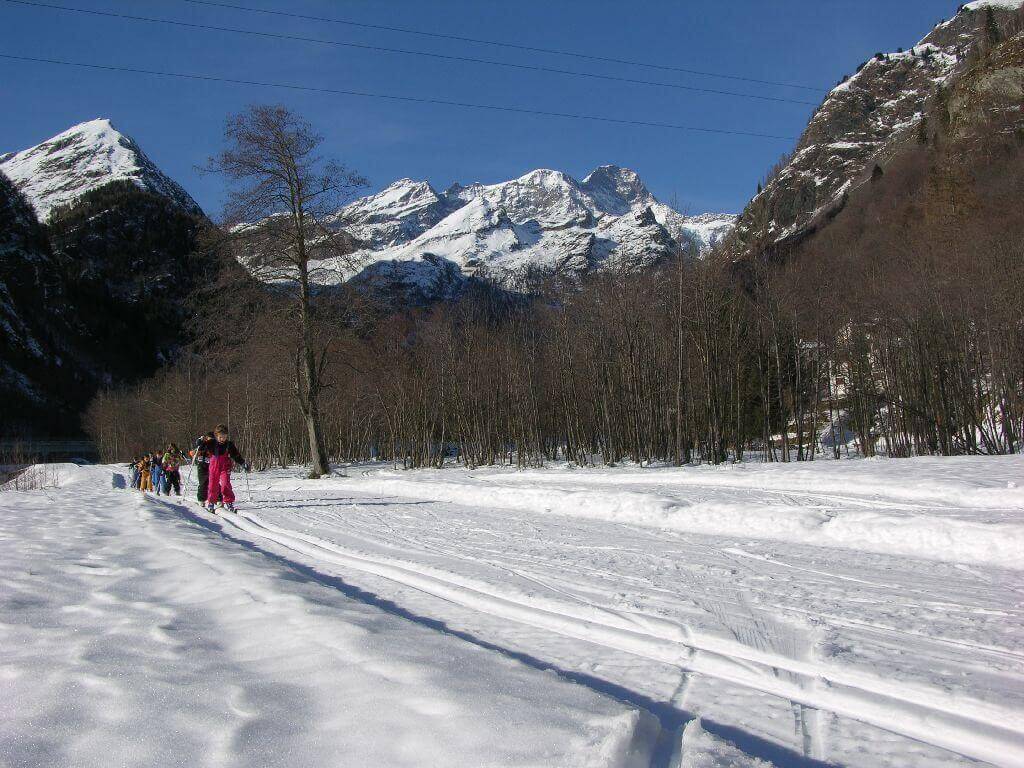
The cross-country trail is located in Riva Valdobbia, just before Alagna. Equipment rental and a chalet for snacks are available, although in recent years natural snow has been supplemented with artificial snow.
Cycle Path Along the Sesia River: From Alagna to Riva Valdobbia
The loop trail along the Sesia River is perfect for family walks. Along the way, you’ll find:
⚠️ Important: When the cross-country track is active, respect the ski tracks and always walk on the free side.
Alagna Winter Playground
The playground remains open even in winter, with equipment kept clear of snow. It’s perfect for children to socialize and build snowmen, while parents can relax at Il Baretto, a café overlooking the park where you can enjoy traditional miacce (sweet or savory local specialties).
Walser Museum: Discovering Local Culture with Kids
Located in the Pedemonte hamlet, 10 minutes from the center, the Walser Museum is housed in a historic building dating back to 1628. A visit allows you to discover:
A weekend in Alagna Valsesia with your family offers the perfect balance of winter sports, fun activities, cultural discovery, and relaxation. Whether it snows or not, the wide range of experiences and the authentic Walser traditions make every stay truly unforgettable for both adults and children.
The Monte Rosa SkyMarathon® is the highest skyrunning race in Europe and one of the most iconic trail events in the world. Founded in Alagna Valsesia in 1992, it has long been considered the birthplace of skyrunning: it was here, in 1989, that Marino Giacometti set the first speed record on Monte Rosa in 3h57’, laying the foundations for a discipline that would go on to conquer the world.
After its last edition in 1996, the race was revived in 2018 with the same pioneering spirit of its early years. The format that made it legendary has remained unchanged: athletes roped together, above the snow line, on a course reaching 4,554 meters in altitude. An experience that goes far beyond a simple sporting competition.
On June 13, 2026, in Alagna Valsesia, four different races will take place, all sharing one defining feature: exceeding 3,000 meters in altitude.
| Race | Distance | Elevation Gain | Format |
|---|---|---|---|
| Monte Rosa SkyMarathon® | 35 km | 3,500 m+ | Pairs |
| Monte Rosa SkySummit | 17.5 km | 3,500 m+ | Pairs (uphill only) |
| Monte Rosa SkyRace® | 25 km | 2,400 m+ | Individual |
| AMA VK2 | 9 km | 2,086 m+ | Individual |
All routes may be subject to changes due to weather or safety reasons.
The races are open to athletes aged 18 to 70 with a valid competitive medical certificate (B1). For the SkyMarathon and SkySummit, high-altitude experience and familiarity with technical equipment are required: harness, rope handling, knots, and via ferrata kit. For the SkyRace, mountain experience and the use of a harness and via ferrata kit are required.
Moraines, snowfields, and glaciers demand proper technical gear. Essential items include:
The event is organized by AMA ASD in collaboration with local and regional institutions. The Monte Rosa SkyMarathon has obtained ISO certification for the sustainable management of sporting events in alpine environments—recognition that reflects deep respect for one of Europe’s most fragile and spectacular mountain ecosystems.
In a sporting world increasingly driven by numbers and performance, this race takes a different path: respect for the mountains, technical preparation, and team spirit. Running on Monte Rosa means confronting altitude, ice, and silence—a physical and mental challenge that, for over thirty years, continues to attract athletes from all over the world.
That is the secret of its longevity: staying true to its origins while never stopping to look upward.
The Alagna Carnival is one of the most authentic traditions of Alagna Valsesia.
Over time, its origins have been preserved through the collective memory of the community and passed down orally from generation to generation.
Although no written sources precisely document its beginnings, this popular dimension makes the Carnival a living expression of local cultural heritage.
Among the most recognizable symbols, the Carnival features Schwi and Schwilja, the pig and the sow.
Created in the 1990s, these masks quickly became iconic figures of the celebration.
Thanks to their first performers, Ivana Valzer and Gianpaolo Orso, the characters gained identity and meaning.
As a result, they now embody the ironic and communal spirit of the Alagna Carnival.

The most representative culinary tradition of the Carnival is Paniccia, a typical Carnival dish. The earliest documented accounts date back to 1959, when a group of residents of Alagna decided to prepare it for the first time on Shrove Tuesday, inspired by the traditions of neighboring villages in Valsesia.
Before the distribution of Paniccia, it was customary to hold the piglet race along the village’s main street—a festive moment involving children, musicians, and residents, with the piglet adorned with a colorful wreath around its neck.
On the morning of Shrove Tuesday, the main square came alive with traditional folk games, including the greasy pole, a symbol of skill and collective fun. As evening fell, small bonfires known as “faschnachtfirljini” were lit in every hamlet, accompanied by the ritual shouts of “Huru”, echoing from one part of the village to another.
The day concluded with the masked ball at the Unione Alagnese, renowned for its elaborate and sometimes unsettling masks, a distinctive feature of the local Carnival.
Today, the Alagna Carnival officially begins on Epiphany Day, with the first ball held at the Unione Alagnese. On this occasion, the Mayor symbolically hands over the wooden keys to the main masks, marking the official opening of the celebrations.
In the days leading up to Shrove Tuesday, the following events take place:
The day ends with the Ball of the “Popolo Porco”, renewing the bond between the community and its traditions.
The deep connection between the Carnival and the identity of Alagna is also evident in the Theatre of Alagna Valsesia, inaugurated in 1900, where the emblem of the pig decorates the front of the stage.
A traditional legend from Valsesia tells of a symbolic rivalry between the Purcei of Alagna, the Garuf of Riva Valdobbia, and the Brusoign of Mollia—a story passed down orally that continues to enhance the Carnival’s charm. Today, besides Alagna, only Campertogno still preserves the tradition of Carnival masks.
The Alagna Carnival is not just a celebration, but an intangible cultural heritage, an expression of identity, memory, and collective participation. A tradition that continues to evolve while preserving its deep meaning in the heart of Valsesia.
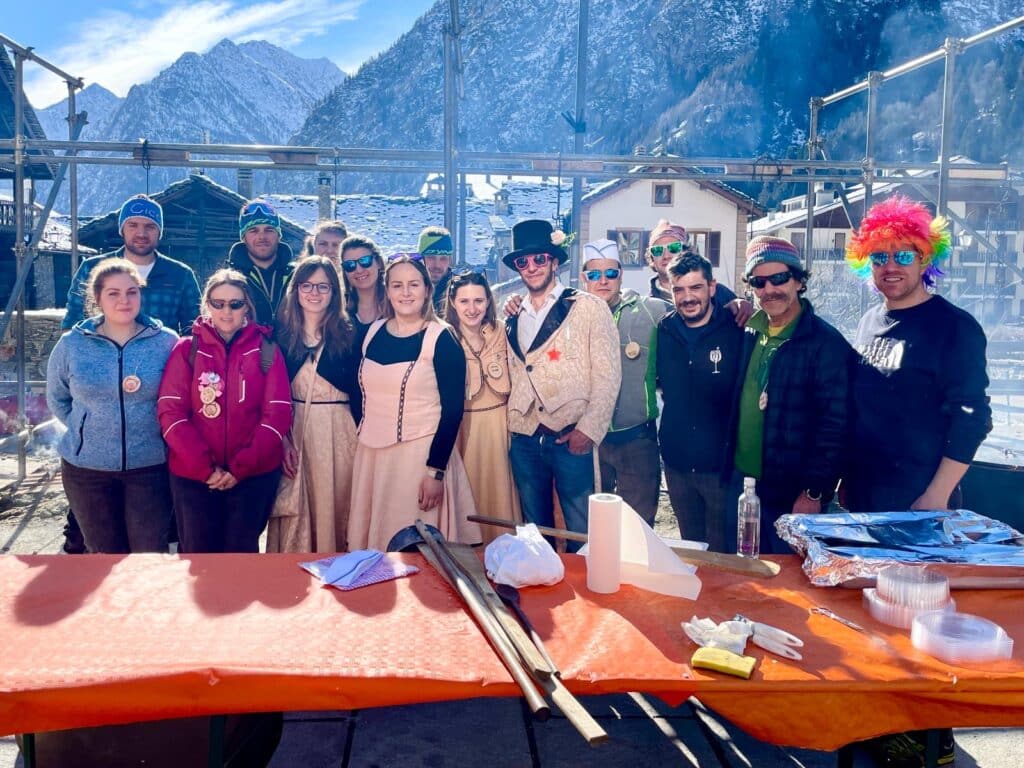
On Saturday, June 28 and Sunday, June 29, Achillea Ewulebi returns — the flower and alpine herb fair that brings the mountain’s flora to center stage.
This unique market exhibition takes place in the heart of the Alps and is dedicated to those who cherish nature, culture, and alpine traditions.
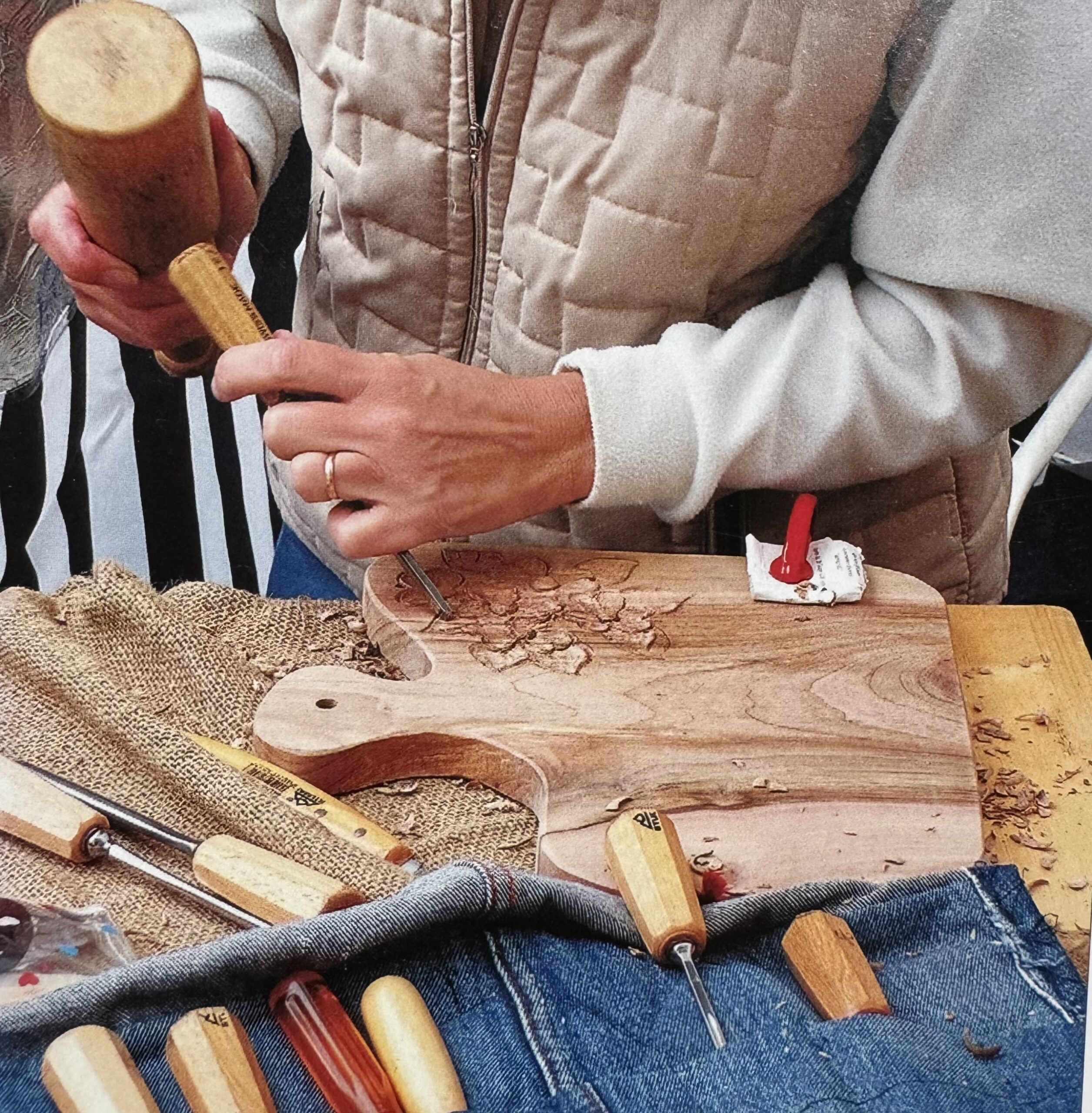
Over the course of two days, visitors will explore a rich display of high-altitude plants, herbs, and blossoms, as well as artisanal creations that reflect the deep bond between people and mountain landscapes: natural fabrics, hand-painted ceramics, wood carvings, and one-of-a-kind handcrafted items.
The name Ewulebi may sound unusual, but it carries a fascinating legacy. In Titzschu, the ancient language of the Walser people, “Ewulebi” means Achillea — a queen of the alpine meadows, long celebrated for its aromatic and healing properties, and even used in traditional grappa making.
Achillea Ewulebi is more than a market — it’s a journey into alpine biodiversity, ancient knowledge, and mountain culture. A must-visit event to immerse yourself in the world of alpine herbs, meet local artisans, and rediscover the authentic beauty of nature.
📍 Don’t miss it on June 28 and 29 — the mountains are blooming for you.
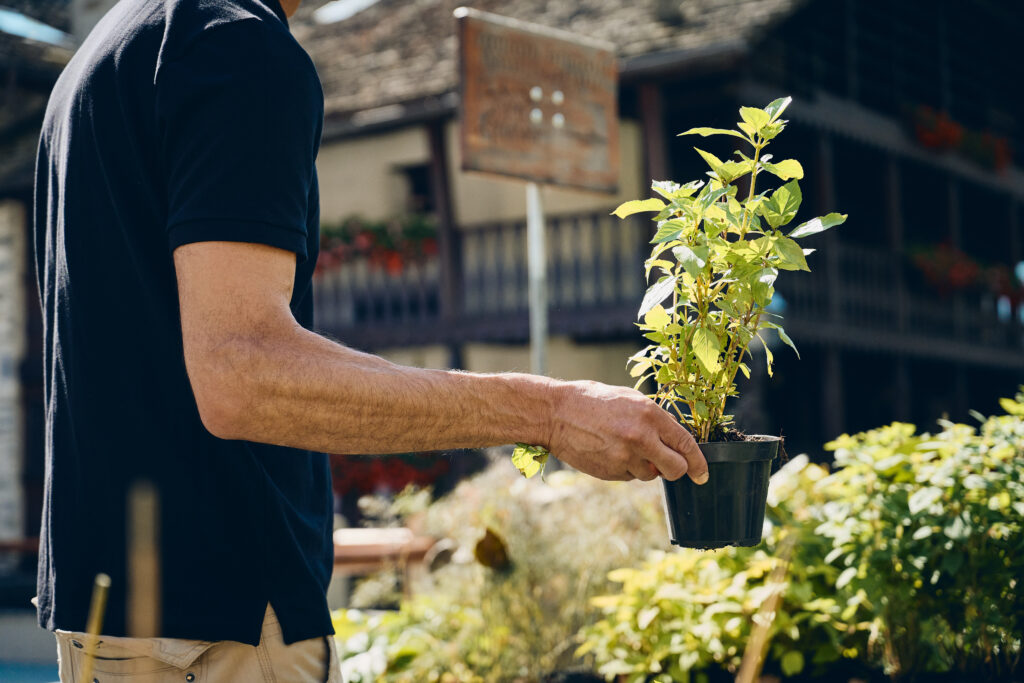
The house where we sleep tastes of fire wood! And of hay and grain and, come to think of it, it also tastes of polenta and salami.
It may be suggestive, but the houses in Alagna taste like ‘ad Brusc’,dialect word to define the whole set of aromas and scents linked to the use of the house as a kitchen, stable, workshop.
In any case, the senses are awakened and so is the desire to be part of that lived-in fabric.
Today I want to ski!
Winter, however long it may be, is always too short for those who love the white dress and the crunch of winter snow under their skis.
As a connoisseur of the village, I cast a quick glance at the forecourts; if the colour of the cars covers the view of the Sesia river, I change my plans and prepare for a walk.
Instead, this morning it seems quiet; I drink coffee from the smiling Erika at the cable car departure point, pick up the skis that Franz and Mattias have carefully prepared for me and embark, ready for adventure and the adrenaline-filled descent.
At the boarding gate I meet Alfredo, the lift historian. He smiles at me and accompanies me all the way to the point where the doors of the lift close, thus updating me on conditions in real time.
The ascent is gentle for me.
At the donkey pole (Zam Eisel the Walser would say) the landscape finally opens up.
I cast my eye towards the Weng alpine pasture and catch sight of the unmistakable zigzagging of the first fresh track.
We are in the territory of Sergio, an expert mountain guide. Only he can have passed through here because he knows the passages.
The track, in fact, seems to end in nothingness. Beyond, only the abyss.
But how beautiful the mountain is! I see alpine pastures, peaks and hills.
I hear the music that Luca, at Alpenstop, sets to fancy, without rules, with only the idea of giving joy.
There, I could already stop for a bombardino but the blue of the horizon calls and I get in line at Funifor.
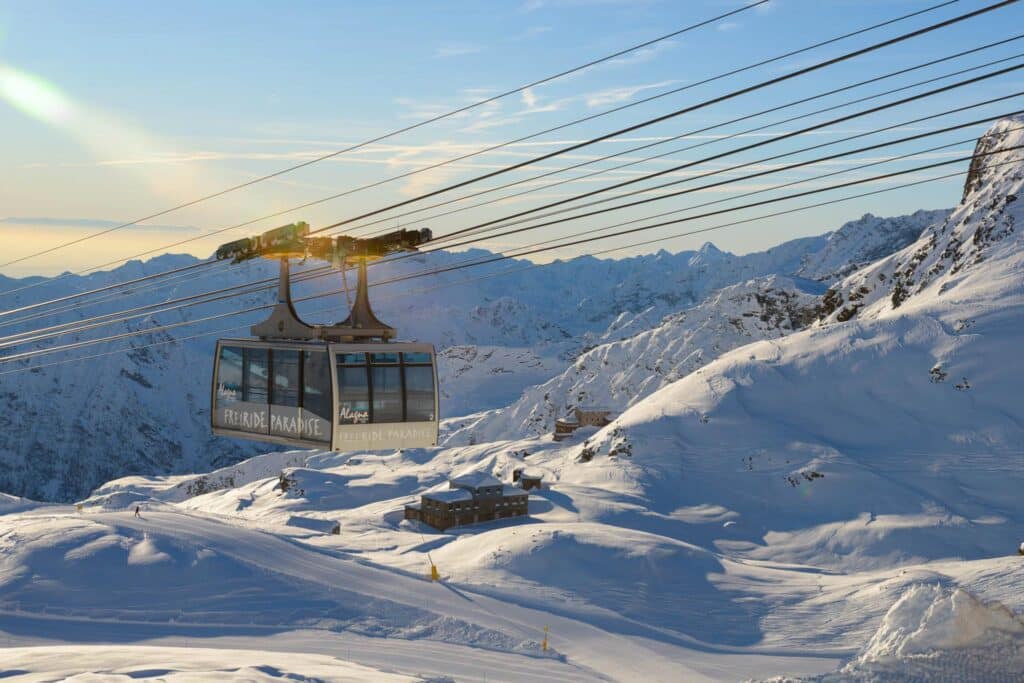
The moving cabin is impressive; it is as big as a room and 100 per cent stable. And that's how it must be to be able to cope with the stormy winds that blow for at least 15 to 20 days in our winter at around 3,000 metres.
By some divine design, they blow mainly when there is tourism so that people think they don't want it.
I smile at the thought.
Not so!
We like people, movement, the exchange of thoughts and above all we like people who love the mountains, nature, traditions.
Overtourism happens but rarely.
Those who come to Alagna are fond of it, it is now part of the decor, as they would say in the jargon.
Ready, go!
There was a time when people used to embark by jostling each other to the cry of ‘travel, all aboard!’
Now everything is quieter, there is even carpeting in the cabin.
The doors close and in less than 10 minutes we are at the Passo dei Salati, at 2980m.
At this point I stop, the Bombardino calls!
Daniele, with his blond goatee and short sleeves despite the temperature, instead proposes a spritz, which I consume on the terrace at the new tables made from the baskets of the historic Balma lift.
We Alagnesi are fond of the memory of that slope (which was an off-piste, and a mouth-watering one at that).
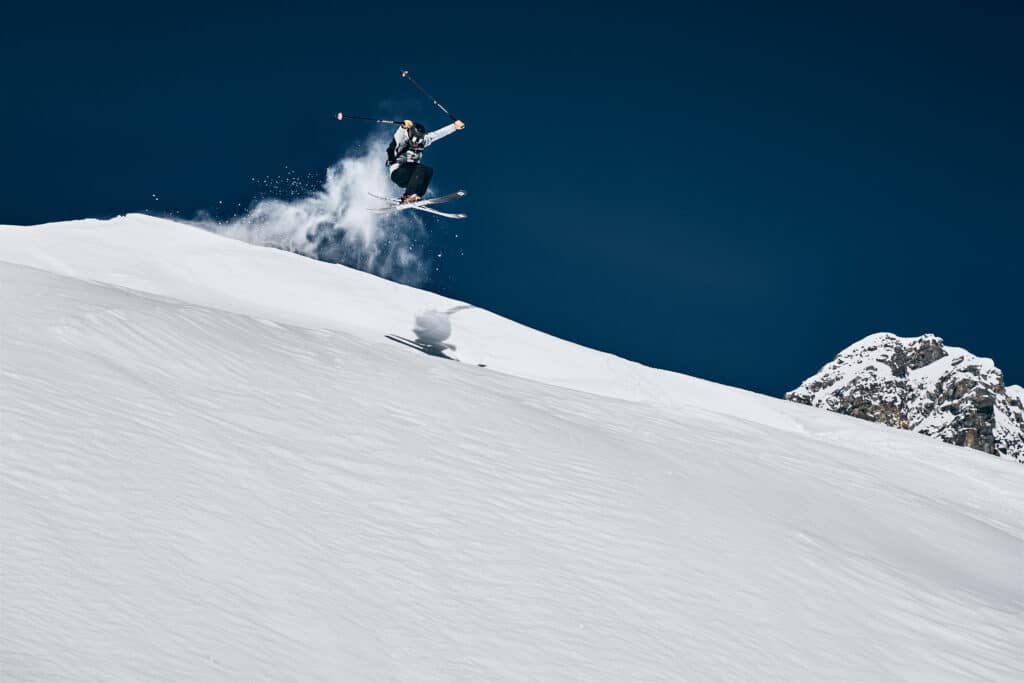
It is no coincidence that we became famous for the Freeride Paradise!
A quick glance towards the Bors glaciers, the old Indren station and I tackle the Olen descent.
A few hundred metres from the entrance to the track, I veer to the right; I feel like visiting
the Mosso Scientific Institute. A leap back in time as the institute was founded in 1907.
Now it has been renovated with skill and passion and there is an interactive, multimedia museum.
Ancient instrumentation alternates with films and narrations.
The Rifugi Monterosa has opened a restaurant with glass windows everywhere right on the terrace of the institute (the project later envisages an accommodation facility with beds as well).
It is thus possible to eat turned towards the Capanna Margherita or looking at the valley and distant borders.
I go there willingly.
Annina, who runs the establishment with Erika, is a familiar face, but only to those with a good leg and who frequent refuges.
The wine cellar is respectable, to the envy of low-altitude restaurants.
I see the staff in the kitchen.
Isham and Erica, always them, always together; now at Mosso now at Capanna Gnifetti.
Annina and Giulia offer me a ‘Bacio di Dama’ biscuit, strictly made by them (I am witness to this, as they knead the dough as they speak to me).
Time is a tyrant.
The black Olen slope awaits me! The entrance is a gully, the grooming is perfect, the snow is almost chalky
Everything is so intimate here.
I think that solitude in the mountains is never real solitude, I think it is rather immersion and contemplation.
How lucky I am to live here!
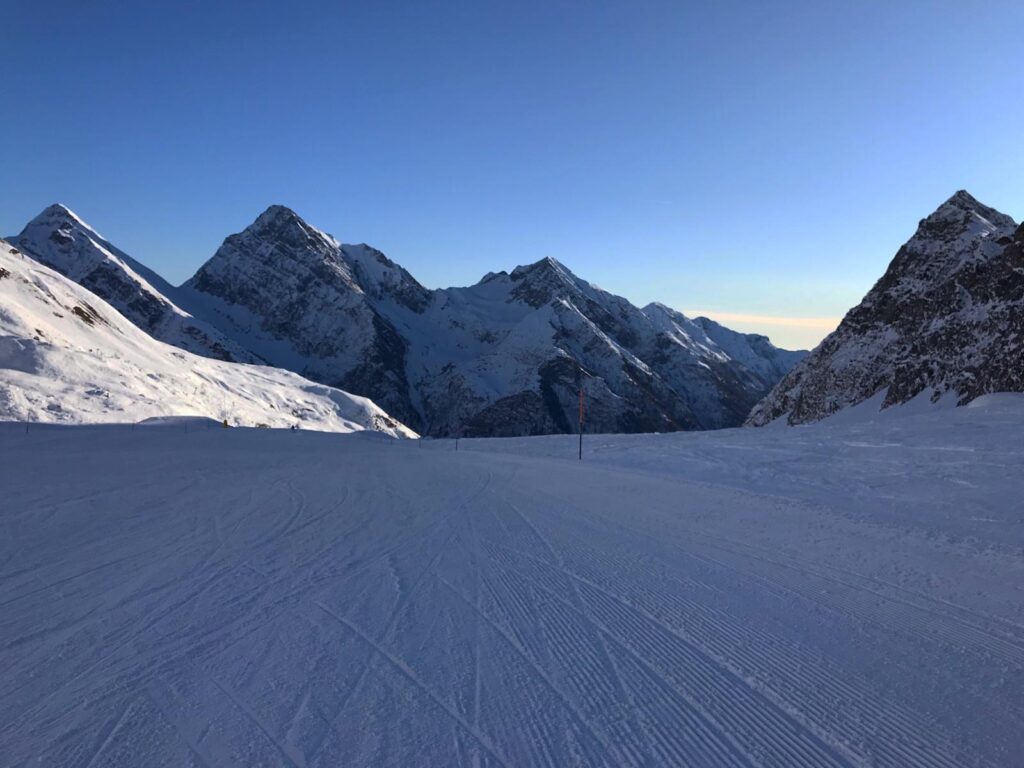
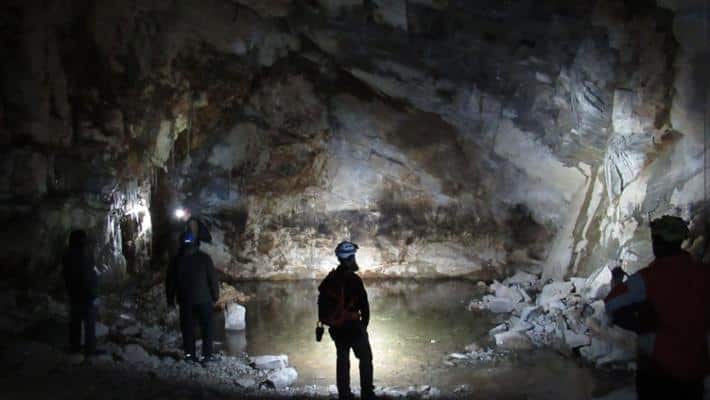
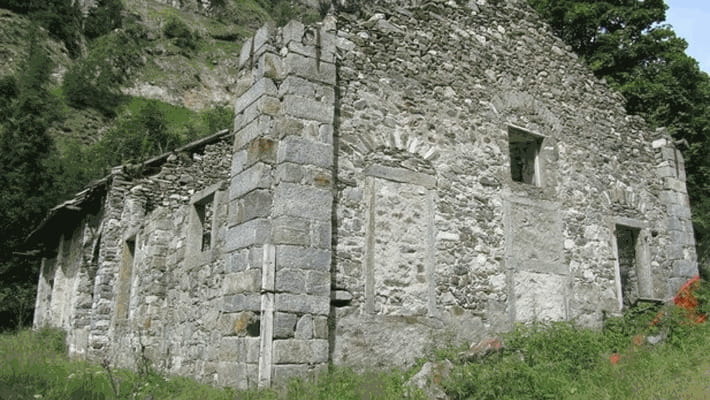
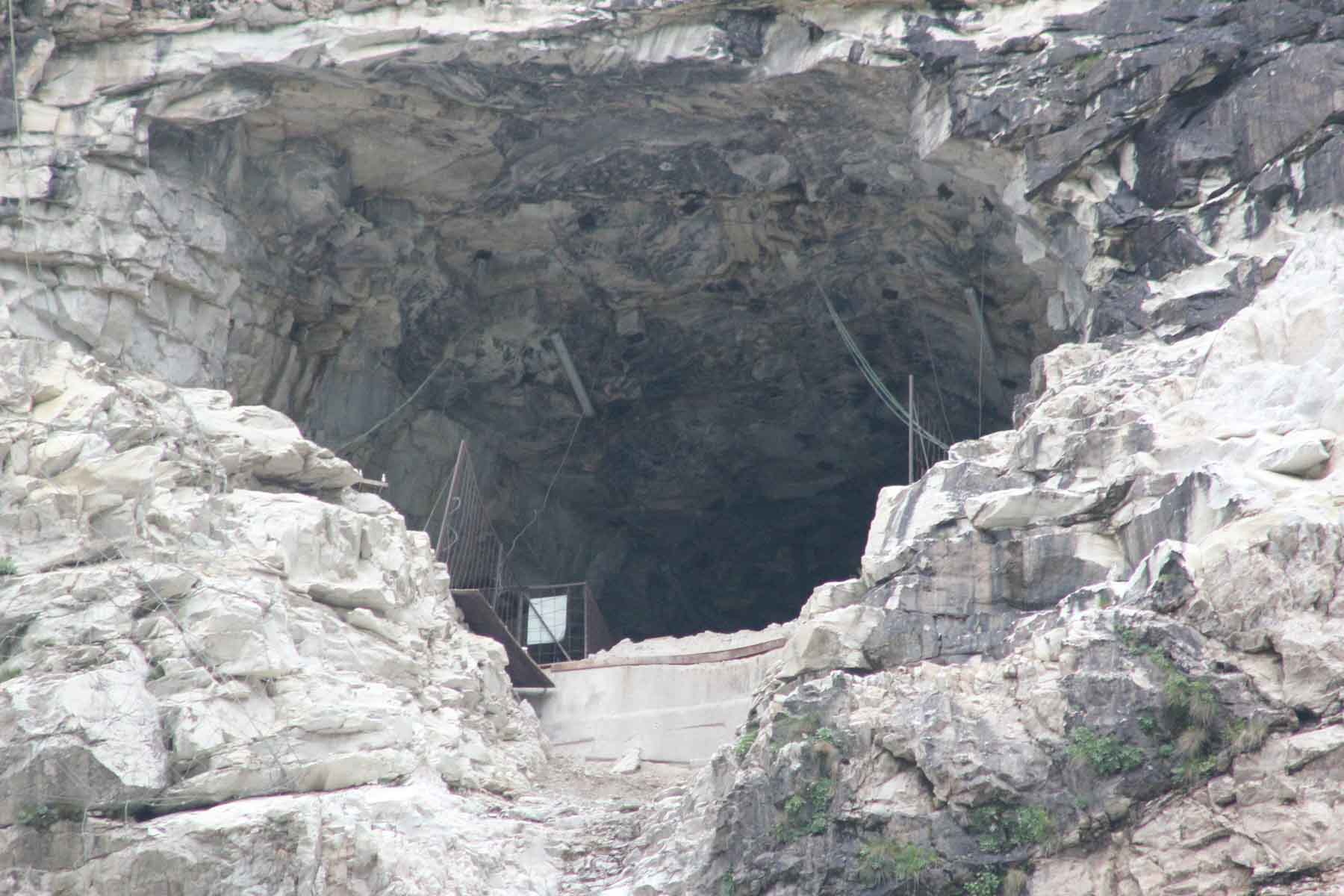
Just outside the village of Alagna, immersed in the breathtaking scenery of the Western Alps, lies a secret carved in stone: the Kreas mining galleries. A place that tells stories of men and gold, of toil and hope, of an indissoluble bond between Valsesia and its land.
Today, thanks to an ambitious project by the municipality of Alagna, this hidden heritage is preparing to come back to light. The redevelopment of the old mines and the San Lorenzo Factory will open a passage in time, offering us the opportunity to relive the past in a unique way.
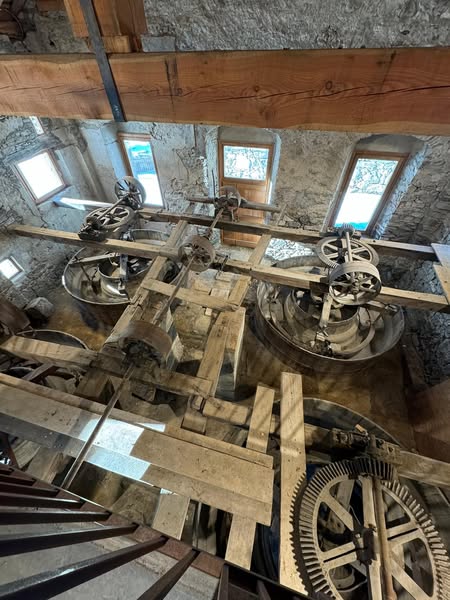
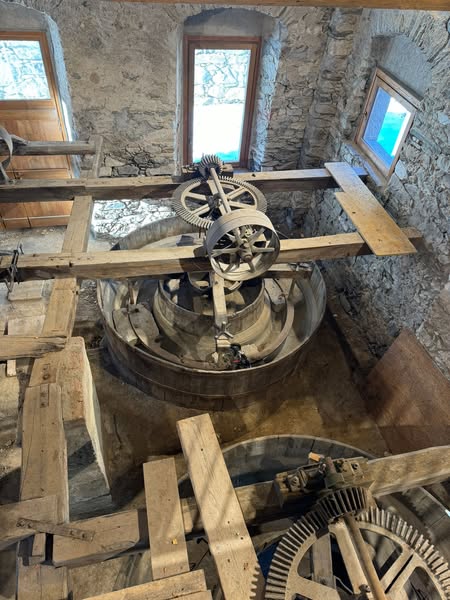
The Kreas Mining Park project has two fronts. The first involves the San Lorenzo Factory, where the gold extracted from the mines was refined in the past. Here, a historic hydraulic millstone, fed by the clear waters of the Sesia river, will be restored to show the process of crushing gold stones. Next to the factory, a new building in harmony with the landscape will house a modern service centre with a ticket office, cafeteria and bookshop.
The second part of the project will take visitors inside the galleries of the old feldspar mine, built on the ashes of the gold mines and active until a few years ago. Here, the fascination of the underground meets the tale of centuries of Alpine labour and resilience.
During the Christmas holidays of 2025, the most curious were able to participate in two preview visits of the San Lorenzo Factory, getting a taste of what the future mining park will be like. Further dates will be available in the coming winter months, offering the chance to immerse oneself in an experience that combines memory and identity.
Valsesia, with its Monte Rosa and its timeless villages, has always guarded precious treasures. The Kreas mines will soon be ready to tell their story again.
Don't miss the chance to discover them!
Here we are close to the end of the Christmas holidays…
Would you like to go sightseeing with us?
We are now going to visit the most suggestive corners of Alagna and show you all the opportunities and unique experiences that Alagna can offer you!
Do you want to experience unforgettable weekends full of emotions?
Come on, let's go!
Here we are at the Wold… If you want to learn to ski, the Wold ski lift is for you!
Children learning to ski, ski instructors and a restaurant on the slope will welcome you.
Next to the ski instructors' hut you will find a small field where the youngest skiers can have fun and a small bobsleigh run!
Take the winter shuttle down to the centre of Alagna and head for the ski lifts.
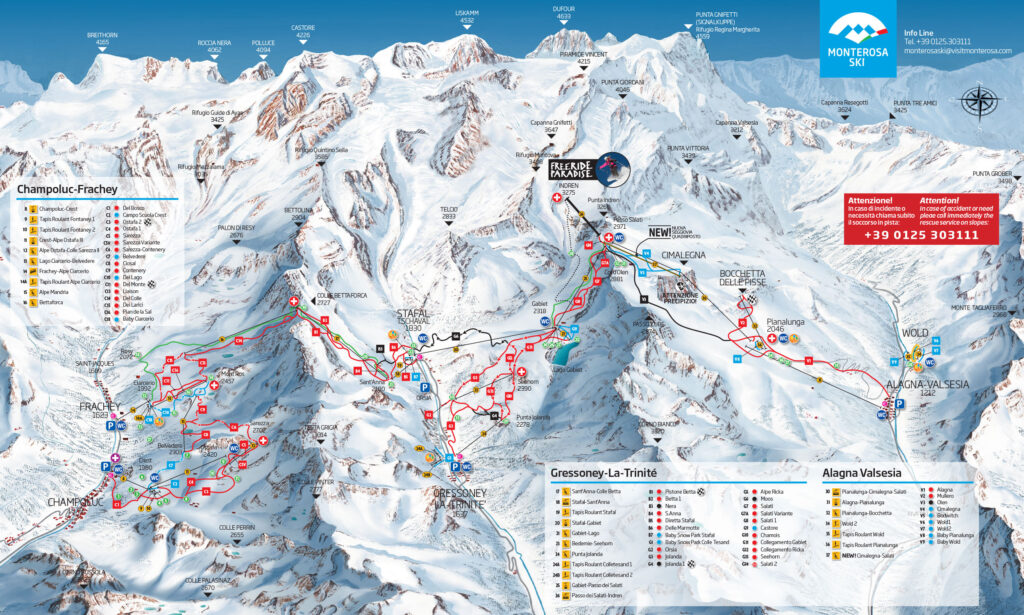
There are 200 km of slopes waiting for you!
This is a vast ski area that allows you to reach Gressoney and even Champoluc!
A day in the company of your friends on the wonderful ski slopes will bring you much joy!
The freshly groomed slopes, the fresh morning wind and the sun warming your face will arouse unique emotions in you.
If you are not interested in alpine skiing, there is no shortage of sports on offer: the skating rink in Alagna and the cross-country track in Riva Valdobbia could be a fantastic alternative!
From this year, the opening of the cross-country track will be guaranteed for the entire season by a new snow groomer and a snowmaking system. This novelty is dictated by the Alagna municipality's motivation in believing in this magnificent sport.
Skating is a much-loved activity for young and old alike, and you can practise it on Alagna's shining rink. The spectacular ice will allow you to experience a unique morning.
… And a hot chocolate after a morning of skating is not to be missed!
In addition to all these opportunities, there are also the many walks that inspire so much wonder.
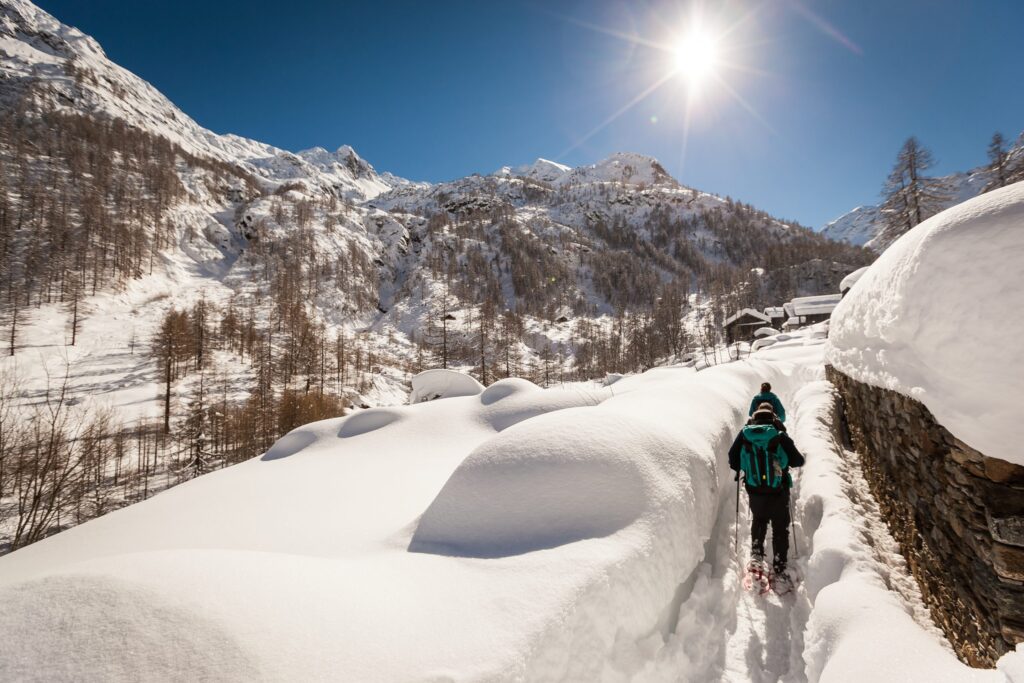
In winter, hiking takes on a wintery guise and becomes snowshoeing. By snowshoeing you can reach the heart of the mountains surrounding the village of Alagna: to Follu in Val d'Otro and to the Walser hamlet of Peccia in Valle Vogna. You can also walk along the Riva cycle path and the little path from Alagna to the Wold.
Our sightseeing tour is over, now it's your turn to try these exciting experiences for yourself!
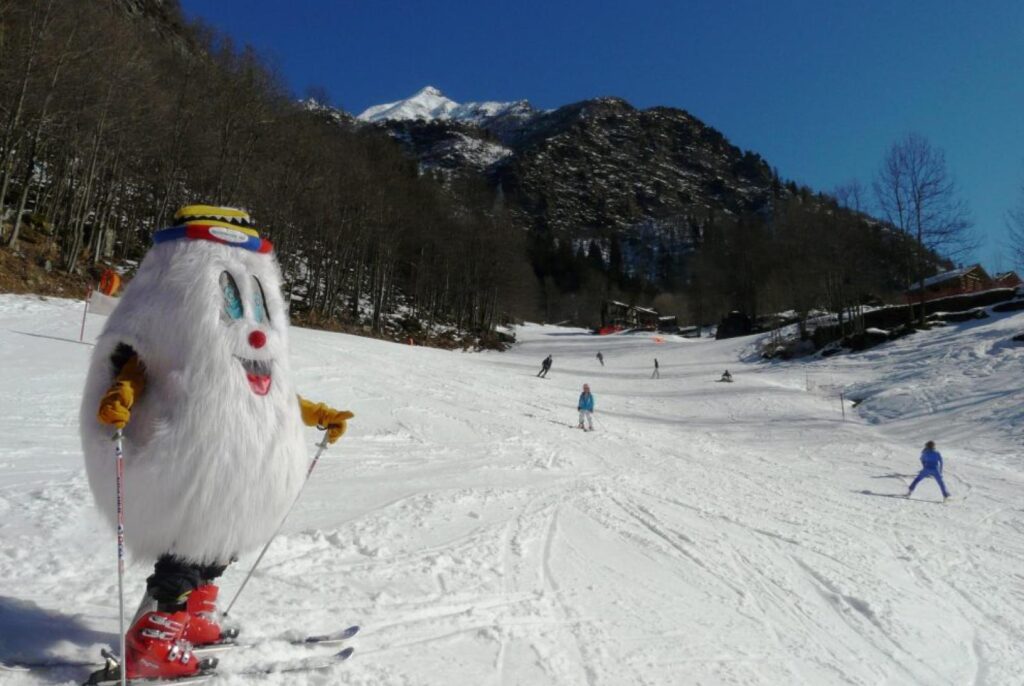
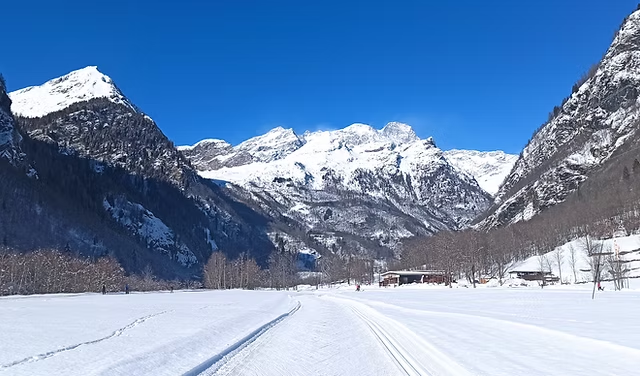
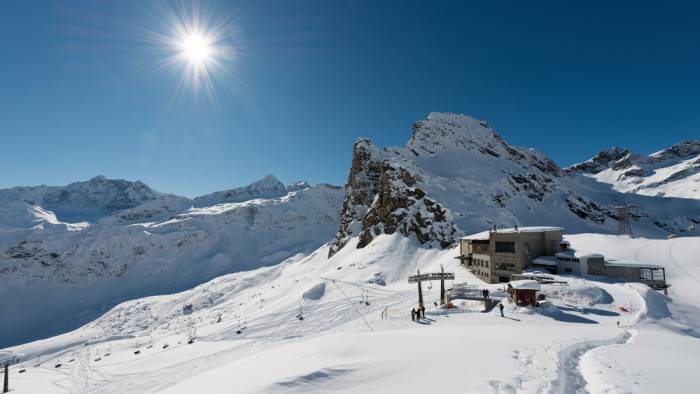
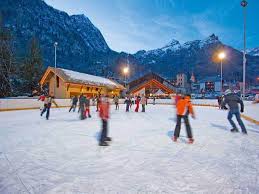
The snow covering the fir trees and the chimneys smoking in the fresh morning air are manifestations of the advent of the new season, welcomed with much joy by the people of Alagna!
As you well know, the winter season is a very important period for our colorful village: this will be enlivened by passionate skiers, many exciting events and those who love the mountains in its warm Christmas atmosphere.
What will most arouse your attention will almost certainly be the opening of the ski lifts!
Starting December 6, ski on your back and off you go on a new adventure. Freshly groomed slopes, Sunshine that will warm your face and hot chocolate are waiting for you charged with energy!
And don't forget that the sporting opportunities offered by Alagna are not just about downhill skiing.
If you are a fan of Nordic skiing, you will be happy to learn wonderful news… This year the opening of the Riva and Alagna cross-country ski trail will be guaranteed throughout the season by a new, more modern snow groomer and snowmaking equipment!
This innovation is dictated by the great motivation of the Village of Alagna in believing in this special sport!
This fantastic time of year brings with it famous and unforgettable customs and traditions.
Among them, one cannot forget the one on December 26 and the one on January 6.
In fact, all the boys and girls were always looking forward to December 26 so that they could go to the Boxing Day dance, where there was no shortage of merry dancing, fun and lots of joy…
Originally, St. Stephen's Day was held in private homes, but with the construction of the Alagnese Union Theater in the early 1900s, the dance found a new official venue. Here the tradition of the famous “Youth Ball” was born.
The event required a precise dress code: dark suit, preferably black, for men; traditional costume and white apron for girls. The evening, in addition to being a time of celebration and sharing, was also an opportunity for cute pranks. Particularly memorable was the rope game: two young men would mingle with the dancers with a hidden rope and, having spotted a couple-often soon-to-be-married boyfriends or lovers eager to keep their relationship a secret-they would throw the rope around the two, binding them tightly. The act would elicit laughter and applause from onlookers, making the evening even more lively. To prevent other engaged couples from suspecting, the “players” would be replaced with each successive round of dancing.
The boys and girls from Riva Valdobbia would go to the dance in Alagna and return on foot in the middle of the night, and despite the harsh winter weather, with all the merriment in their hearts, the cold did not make itself felt!
Tradition has it that on the night of January 5, the girls would put a cup full of water outside the window and the next morning, the drawing that appeared on the ice created would represent the work of their future husband!
We wait You for the time when our little village is surrounded by the beautiful snowy mountains to experience days full of happiness with us!
The most magical time of the year is upon us.
Despite the frenzy that Christmas brings, the atmosphere of surprise, magic, sharing and expectation, have the upper hand.
If you want to experience all these emotions in advance, then you must plan a weekend in Alagna!
Cradled between vertical walls and formed by many small hamlets, Alagna looks like a small crib.
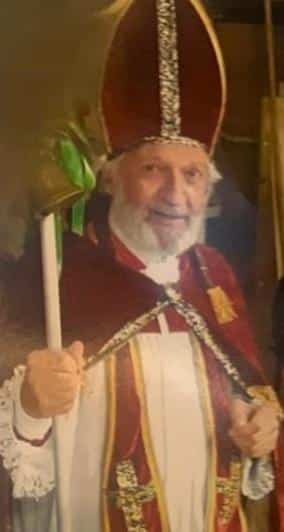
Tradition has it that in Alagna the Santa Claus arrives on December 6, for St. Nicholas (for our Alemannic ancestors it was Sankt Niklos).
The Saint's arrival was eagerly awaited by the little Walser children; the only time of the year when they received a longed-for present.
They did not live poorly since the territory provided enough for subsistence but having the gift of sweets or new scapins for the winter, brought by night by an old man with a long white beard and his faithful donkey was another story.
The preparation ritual was repeated in every home: before going to sleep in the alcove upstairs, a cup of milk and a piece of bread had to be prepared for the odd couple of wayfarers who left gifts in return.
Now the tradition is repeated: an authentic Sankt Niklos harnessed as a bishop and his faithful servant brighten the spirits of the little people of Alagna on the night of December 5-6.
This is followed by Mass in the small church in Pedemonte and the throwing of sweets (over the years they have slowly replaced mandarins, once the only delicacy).
It is the time of the first snowfalls, much expected.
Snow, it is known, for mountain people is bread and relaxes the spirits of those who invest in the area.
What kind of winter will it be?
The December 2 Santa Bibiana, snow merchant in case St. Andrew and St. Catherine were dry, nevertheless decrees the weather for the next 40 days.
Believe it or not, but it works!
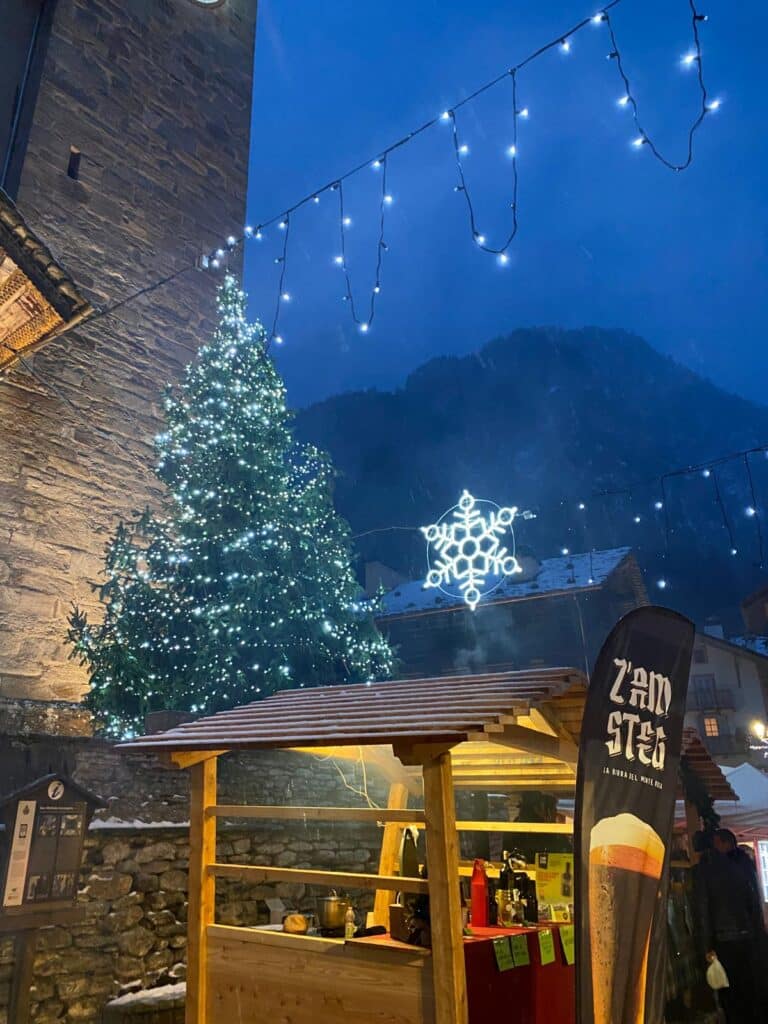
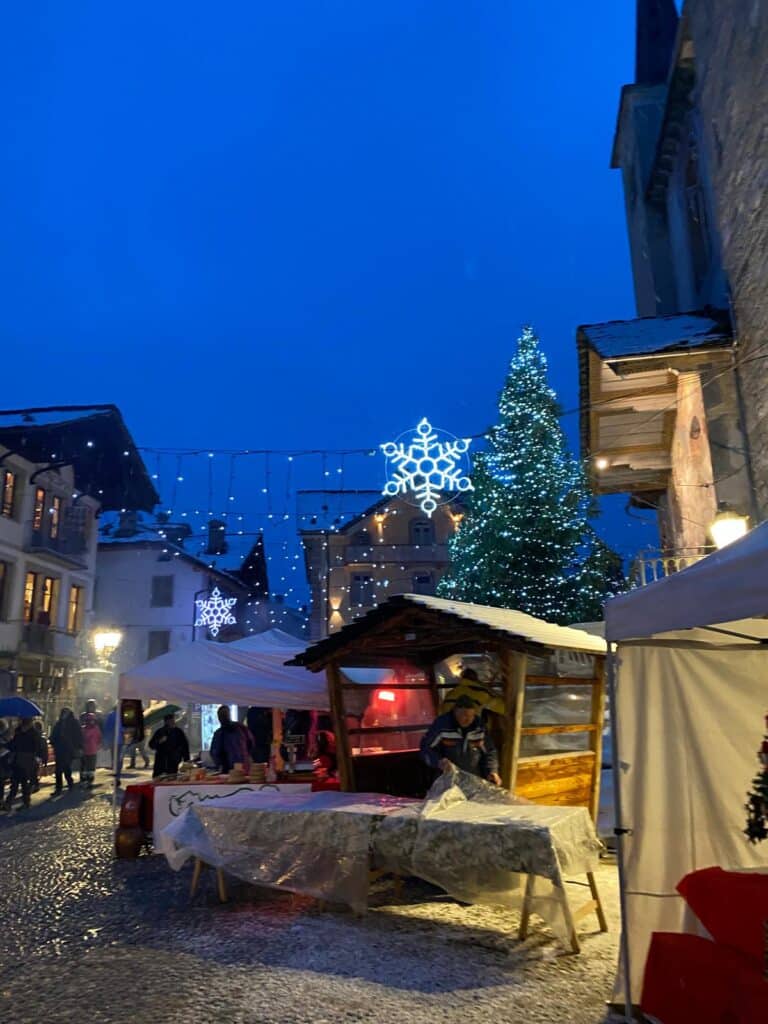
During the Immaculate Conception weekend, the street comes alive with Christmas markets; an excellent opportunity to learn about and buy local products and experience the warm and fragrant atmosphere that preludes the winter vacations.
Candles that smell of orange and cinnamon, furry pillows and handmade blankets, scarves and slippers.
Christmas cookies, hot chocolate and mulled wine.
Music, dancing and sharing around the brazier.
If you, too, are a winter-loving dreamer and your thoughts take you to memories of faraway Christmases, lived amidst choice hugs and family traditions, Alagna is your place!
The autumn month of November, with the harsh cold, the burning wood stove and the eerie darkness that accompany it, is approaching. Add to this the mysterious legend of the dead, and in the blink of an eye we find ourselves catapulted into the ancient Walser legends that bind the 13th century to the present.
What face did death take on in Walser life?
That of the Walser was, certainly, not a simple life; their existence was marked by sacrifice, a lot of work and painful death. How, then, did they endure such a “hard” life?
Thus some legends were born that could fill the void left by the lack of rational answers to the questions posed to the difficult existence and the harsh environment that surrounded them.
Imagine yourself in a Walser home, the darkness of the evening and the snow falling… These legends also had the function of enlivening the long winter evenings!
And what happened when a family member left their family?
… Not only the material dimension was involved in the mystery of death….
Houses were, in fact, equipped with the window of the soul.
And aren't you curious? Let's find out what it is right now!
The soul window is a small opening placed in the wall of the stube (room with a stove) that was opened when a family member died to release his or her soul bound for the glaciers of Mount Rosa and was closed again immediately afterwards so that the soul itself could not return.
Let us examine together a mysterious and “eerie” legend that animates the hearts of the Walser people as autumn and the month of November arrive.
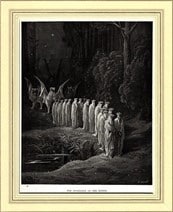
Legend has it that at midnight on November 1, the souls of the dead emerge from their graves to gather, then, in a long procession headed toward the Bors glacier.
Each soul proceeds with its little finger lit like a candle, acting as a guide through the dark path!
What if this procession of souls encounters a living soul? This one is stopped and knighted by giving it a miraculous staff to guide the procession and it is allowed to make a wish!
And are the penances the same for all souls?
If the procession encounters a ravine or a stream, the most sinful soul must stretch out its arms and legs to reach the opposite bank, thus making itself a bridge for others.
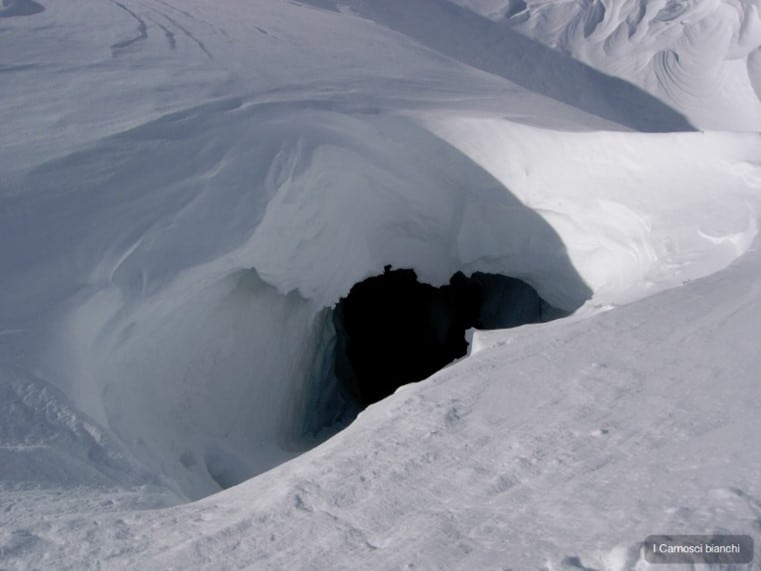
Before dawn the procession reaches the glaciers, and here the souls atone for their sins by tapping the ice with pins; the sound spreads through the valleys!
From this legend was born the custom among villagers to turn their ears to the mountains on the night of November 2 to listen to this sound.
If you would also like to take part in this custom you will feel a thrill in your heart at the thought of what this represents!
A later legend says that, not so many years ago, a gentleman met, near the Bors Glacier, a good woman with a cloth bag on her shoulders, from which a wooden handle protruded.
What was she doing? She was on her way to the glacier to build small steps so that the soul of her mother, who had died a few days earlier, could ascend more easily….
In fact, as Ravelli told us in 1924, many villagers were wandering in the glacier as if they were in a shrine, “…bending their bare knees on the living glacier and praying for the souls of their sorrowful ancestors and for the preservation of themselves from such a hard punishment after death…”
Although not very cheerful, this legend awakens many emotions in our hearts and makes us feel a feeling of love for our dear Walser ancestors, who made so many sacrifices and labors to realize their culture together with the wonderful Walser villages!
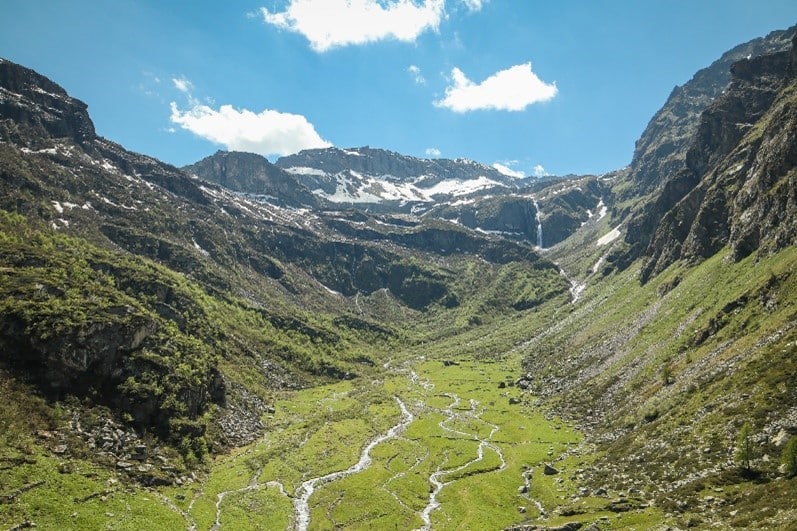
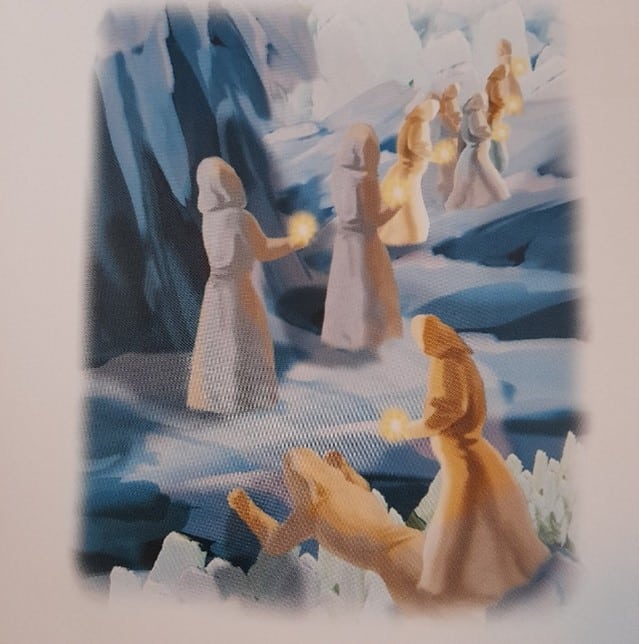
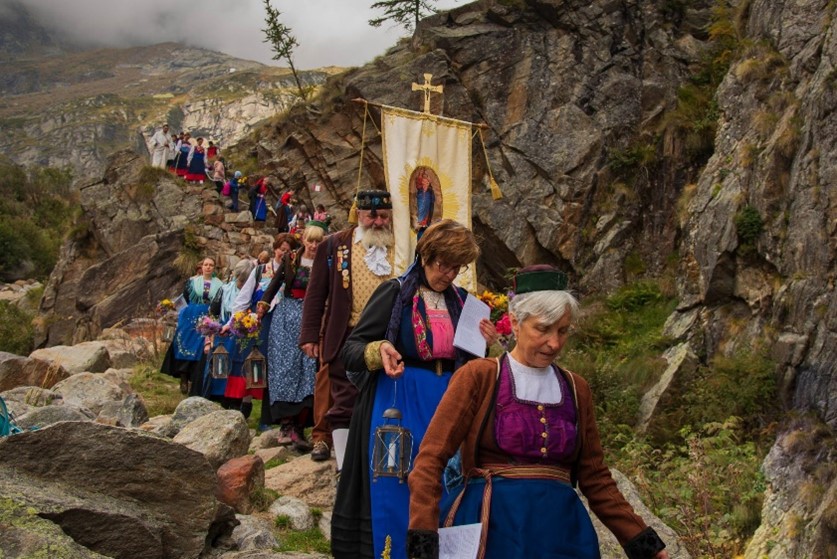
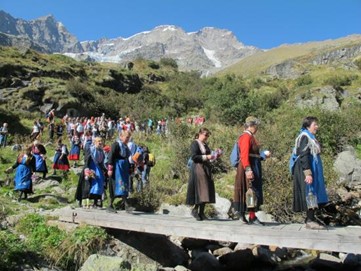
Amidst exciting traditions, Walser culture, myths and rituals, on the first Sunday of October we welcome you to the devotional Flower Rosary procession.
But what is it all about? Let's dive into the history for a few moments and discover some interesting facts!
That of the Flowering Rosary is a long history dating back to the 17th century; the Walser inhabitants of Alagna would go, on this important day, to the Sesia Glacier in function of thanksgiving for the great and effective summer season spent in the mountain pastures and to remember, by praying, the souls of their deceased loved ones, who wandered there in the form of butterflies!
Another hypothesis suggests that this Celebration requested God's protection from the advancing glaciers of Monte Rosa, since the period was that of the Little Ice Age.
From 1689 until the year 1900, the procession was held every year, only to be sadly forgotten for a few decades. The dear Don Carlo had the great merit of restoring this tradition so that it could be handed down and lived in joy!
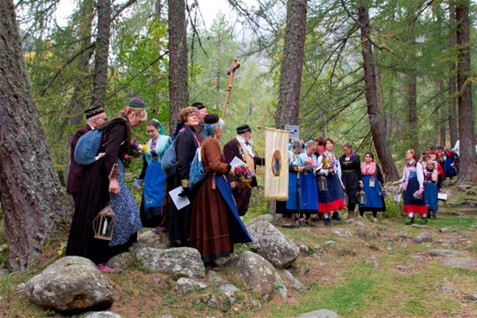
Let's take a step back in time and imagine the departure in front of the glacier, under the wall of Flua, seeing the candles light up in the lanterns and listening to the prayers sung in Latin and in Tizschu…
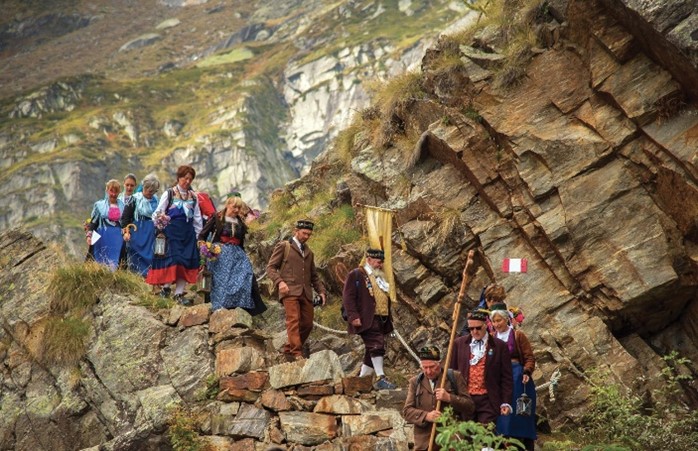
The people of Alagna are also joined by the Walser communities of Rima, Rimella, Carcoforo, Macugnaga and Gressoney: you can admire the beautiful and characteristic Walser clothing.
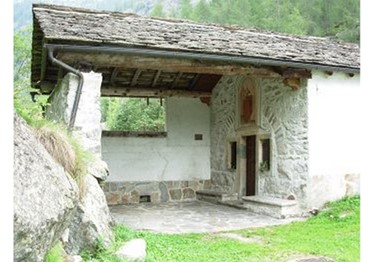
And there, immediately the descent begins: we start from the altitude of 1850 m to arrive at the Oratory of St. Anthony at 1385 m where Holy Mass and Te Deum will be held.
Along the way we will stop seven times; at each stop you can listen to the delightful singing of hymns and prayers and admire the offering of flowers to Our Lady.
The final part was always the most popular with the children; we would all snack together and leftovers would be thrown into the crevasses to feed the souls who lived there!
The more curious may wonder why this procession is called the “Flower Rosary.” Here is the answer!
This designation was chosen to recall the ritual of throwing mountain petals and flowers at each mystery.
Rituals, myths, prayers in Titzschu, Walser culture and a lot of love; an ancient tradition takes us into the past to make us experience unique emotions remembering the Walser ritual of the Flower Rosary!
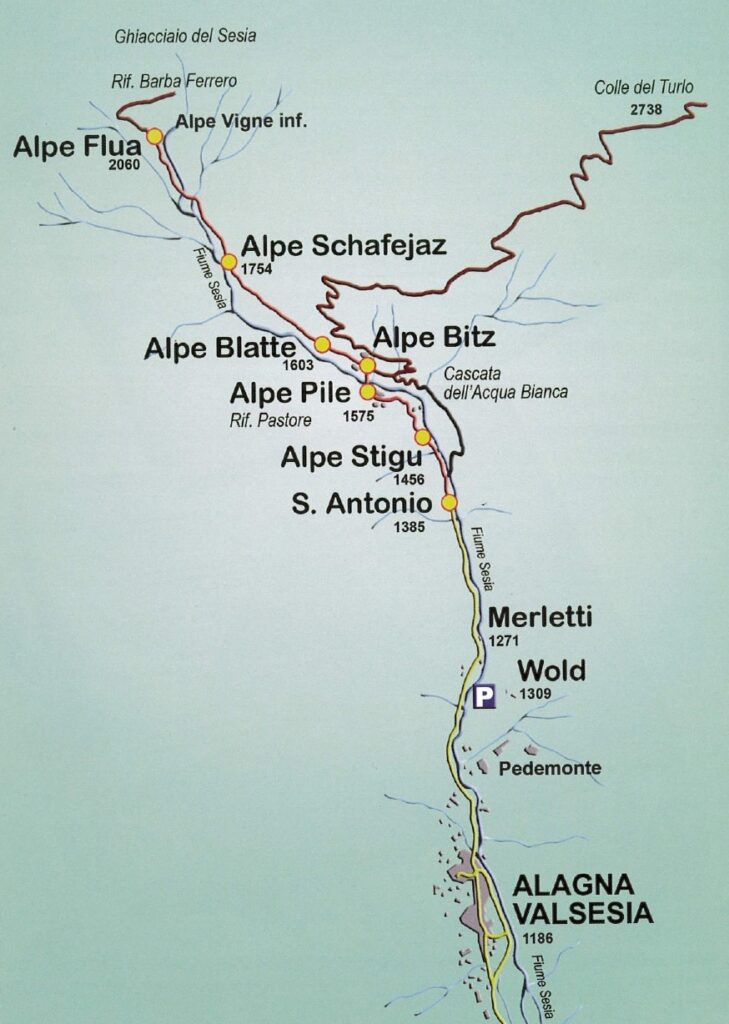
As has been the case every year since the 15th century, in the early autumn of September, the Historic St. Michael's Fair will be held during the last week of the month.
In its origins it was a real market, in which villagers, but not only, prepared to face the cold and long winter. Even residents of Gressoney would cross the Valdobbia Pass to visit and shop at the Fair!
In this market you could find a little bit of everything, from winter clothing to handicrafts; in the first square of the village, they even brought the cows of Riva's shepherds!
Imagine Riva immersed in a festive autumn atmosphere, with many people ready to welcome those arriving for the Fair visit, children running around, and the music of accordions!
Over the years, this beautiful Fair has undergone some transformations; first of all, cows are no longer brought in, and from a real market it has become a craft fair in which exhibitors from all over the Valley and Piedmont come to the little village at the foot of Monte Rosa to display their products, created with so much patience and love.
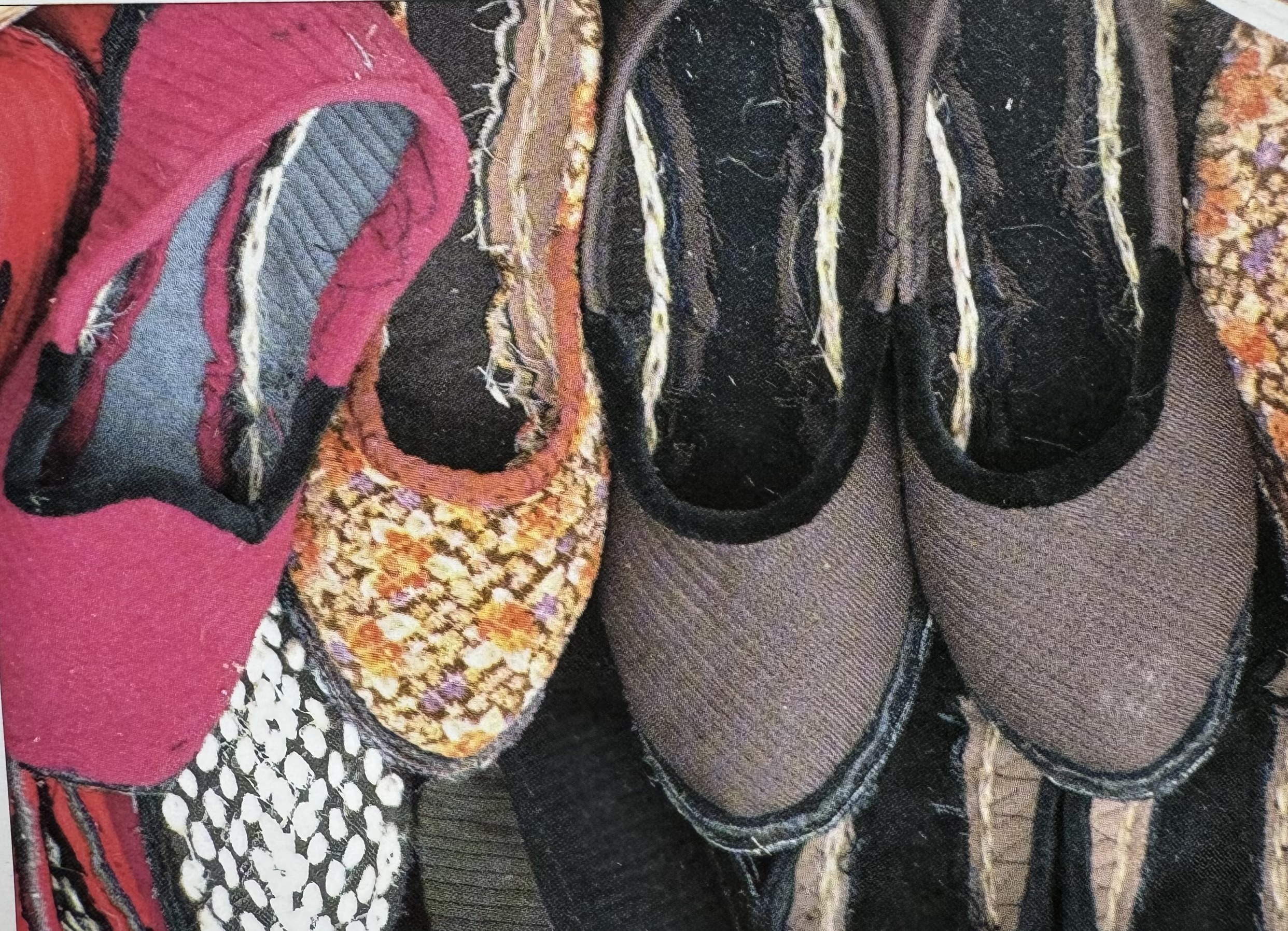
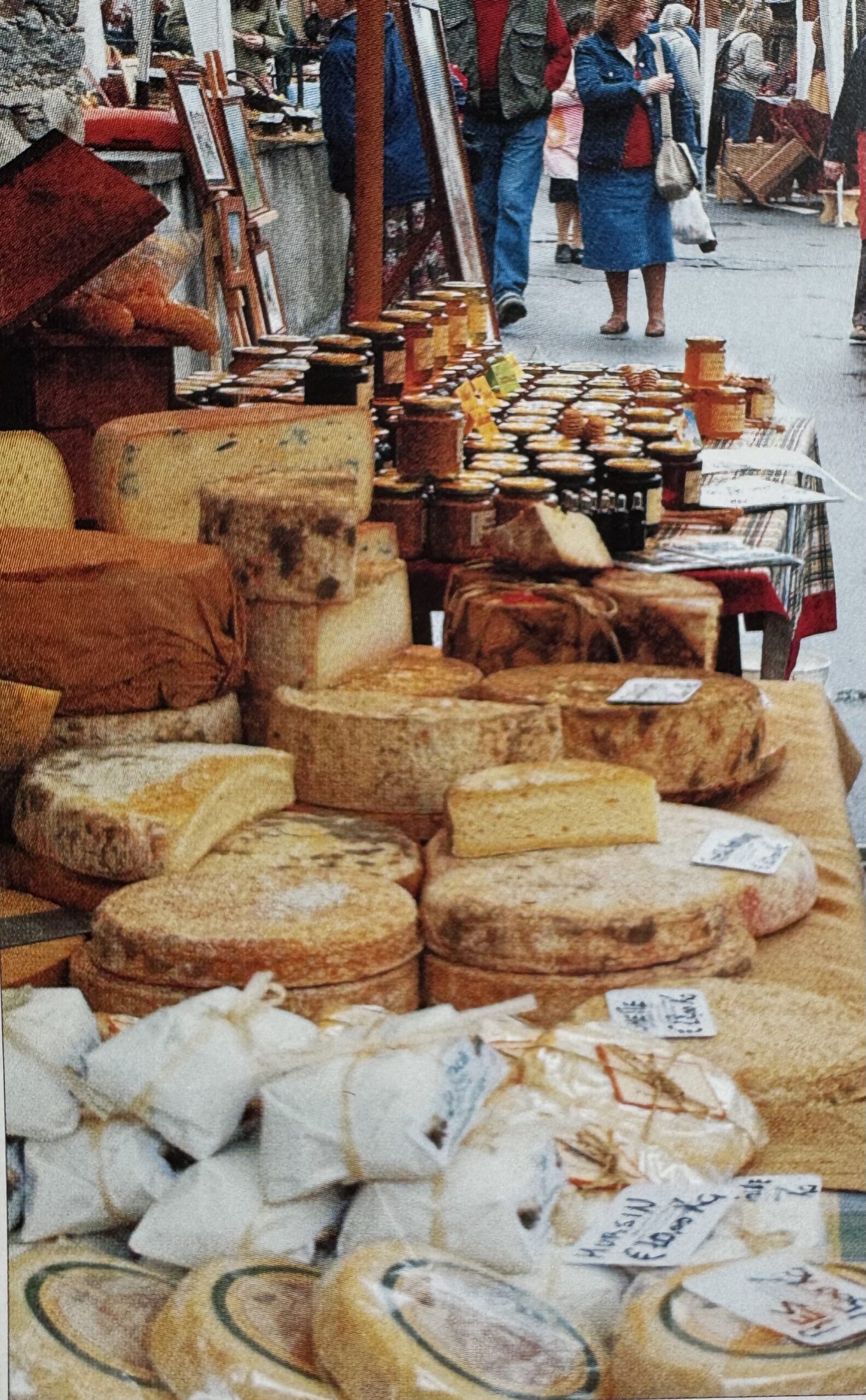
Waiting for you will be stalls with local handicrafts (with typical Walser slippers: the so-called “scapin,” panniers, scarves, woolen caps, and beautiful wooden products) and stalls with Valsesian food products (cheese, fruits and vegetables, honey, and, above all, miacce: our specialty!).
You cannot miss the delicious masarai potatoes, usually cooked in the morning, and the apple fritters that will follow in the afternoon!
The Pro Loco of Riva will welcome you near the charming Church with sausages and delicious pizzas prepared with such passion by volunteers in Riva's historic bakery!
… Fresh autumn air, accordion music, handcrafted products, local foods and, above all, a lot of will to pass on a long tradition…
We look forward to seeing you on Sunday, September 29 in Riva to enjoy the carefree atmosphere that only the Historic St. Michael's Fair can offer!
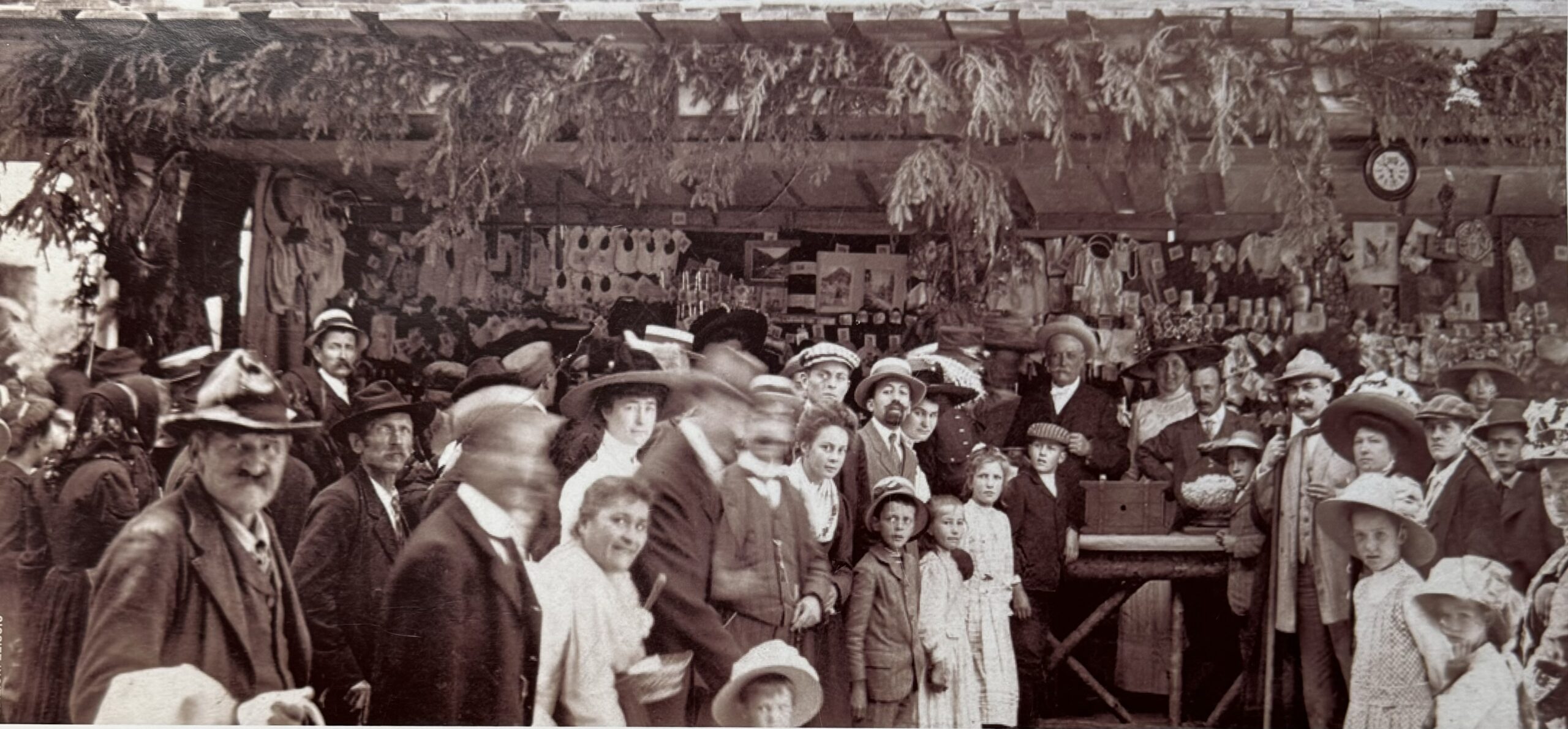
The one at Alpe Pile is a hike suitable for families, children and mountain enthusiasts.
We are at the Wold parking car, backpacking, see the shuttle and we go!
We park our car at the parking lot of Wold, the last parking lot in Alagna and here we can see the winter ski lift and imagine the snow-covered meadows with children having fun skiing.
In front of us is the shuttle waiting for us, we take the ticket and in less than 10 minutes here we are at Acqua Bianca (1450 m). We stop for a few moments to admire the spectacular waterfalls and immediately take the trail number 206.
In less than 10 minutes we are facing another waterfall, these are the so-called "Boilers of the Sesia," what a wonder!
An "obligatory" stop is at the Visitor Center and Botanical Garden at Alpe Fum Bitz.
These are located in the highest protected area in Europe: the Alta Valsesia Nature Park, at an altitude of about 1,600 m.
The garden was established in 1999 and is home to a wide variety of species and large floristic-vegetation areas where there are 131 types of flowers.
You can find it open in summer, or by reservation at other times of the year; you can, thus, acquire all the news about the flora and fauna of the Park!
In about 20 minutes of walking, here we are at Alpe Pile (1575 m) where there is Rifugio Pastore and a splendid view of Monte Rosa; this is one of the most important viewpoints on the South Face of Monte Rosa.
In addition to the many meadows and pastures, there are high rocks here with round-shaped erosions called "Giants' potholes". It is thought, in fact, that giants have passed through and these have left their footprints!
These cavities are actually the result of the significant erosive action exerted by the glacier.
Children really like to play on these rocks, also because in the "Giants' potholes" there are some tadpoles.
The Refuge was built in 1972, and the Varallo Sesia section of the Alpine Club dedicated it to the memory of member Francesco Pastore, brother of then sectional president Gianni Pastore, who died prematurely in a car accident.
The building consists of four characteristic, completely renovated huts where larch wood and typical Valsesia stones predominate.
In the main building you can find the restaurant offering excellent cuisine and the bar equipped with a large panoramic terrace. In the adjoining lodges you can find the dormitories and dormitories.
Let's not forget that there are binoculars outside the Refuge that will allow you to admire all the peaks of Monte Rosa!
The Refuge offers a dedicated space for tents; if you want to experience the mountains under the stars, this enchanting place is for you!
The lodge offers a stay in a facility surrounded by nature and overlooking Monte Rosa. Waking up, opening the window, feeling the fresh air on your face while observing Monte Rosa right in front of you, will give you all the energy to live a day full of emotions!
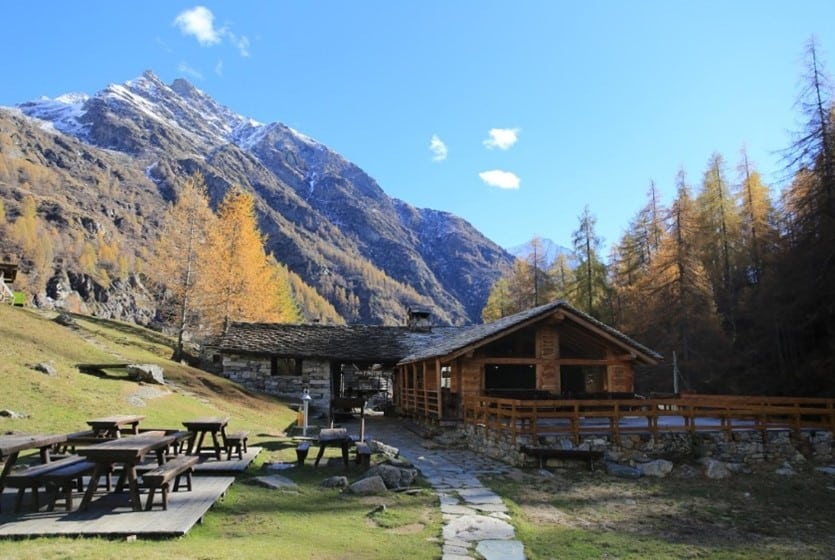
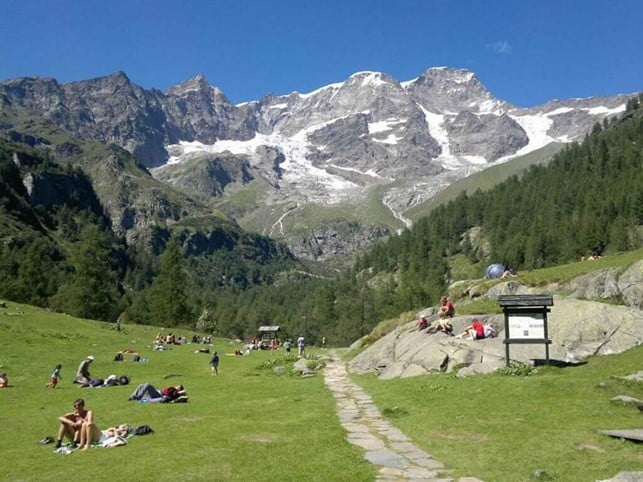
We are in Valle Vogna, at Cà di Janzo, and in about fifteen minutes we arrive at Sant'Antonio, where we make a brief stop to drink a coffee that gives us energy to tackle our climb.
The Abbot Antonio Carestia, an illustrious botanist, mountaineer, expert parchment translator and the man to whom the hut that will welcome us in a few hours is dedicated, lived in this splendid hamlet in the 1800s.
Along the dirt track we find a drinking fountain that offers us fresh water to fill our water bottles. We now arrive at the crossroads and follow the signpost 202, which takes us to the Rifugio Abate Carestia.
The path immediately becomes steep, but we do not realise this so much as we are immersed in the splendour of the nature that surrounds us.
When we reach the hamlet of Piane, we admire the hamlet of Peccia for a few moments, where there is a bright little artificial lake and numerous Walser houses. We set off again!
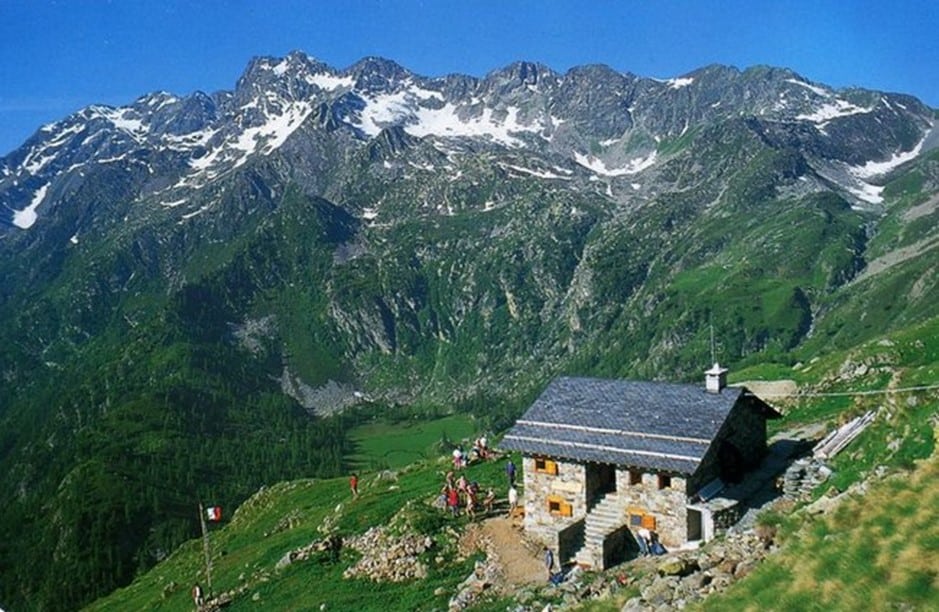
After two and a half hours, we arrive at Rifugio Abate Carestia (2201 m). Fatigue sets in but the view comforts us, giving us the strength to continue our ascent to admire as many natural wonders.
Here is an ibex! We are almost certain to meet many more; ibexes love to live in this area and run up and down these slopes.
We smell a good scent coming from the refuge, but alas, lunch is waiting for us on the way back….
The Rifugio is a large stone building, surrounded by high peaks and flanked by a clear stream; an ideal place for a relaxing weekend away from noise and daily stress.
It has a bar-restaurant and 30 beds. The building, dedicated to Abbot Carestia, was built in 1995 to replace the old construction that had become unsafe.
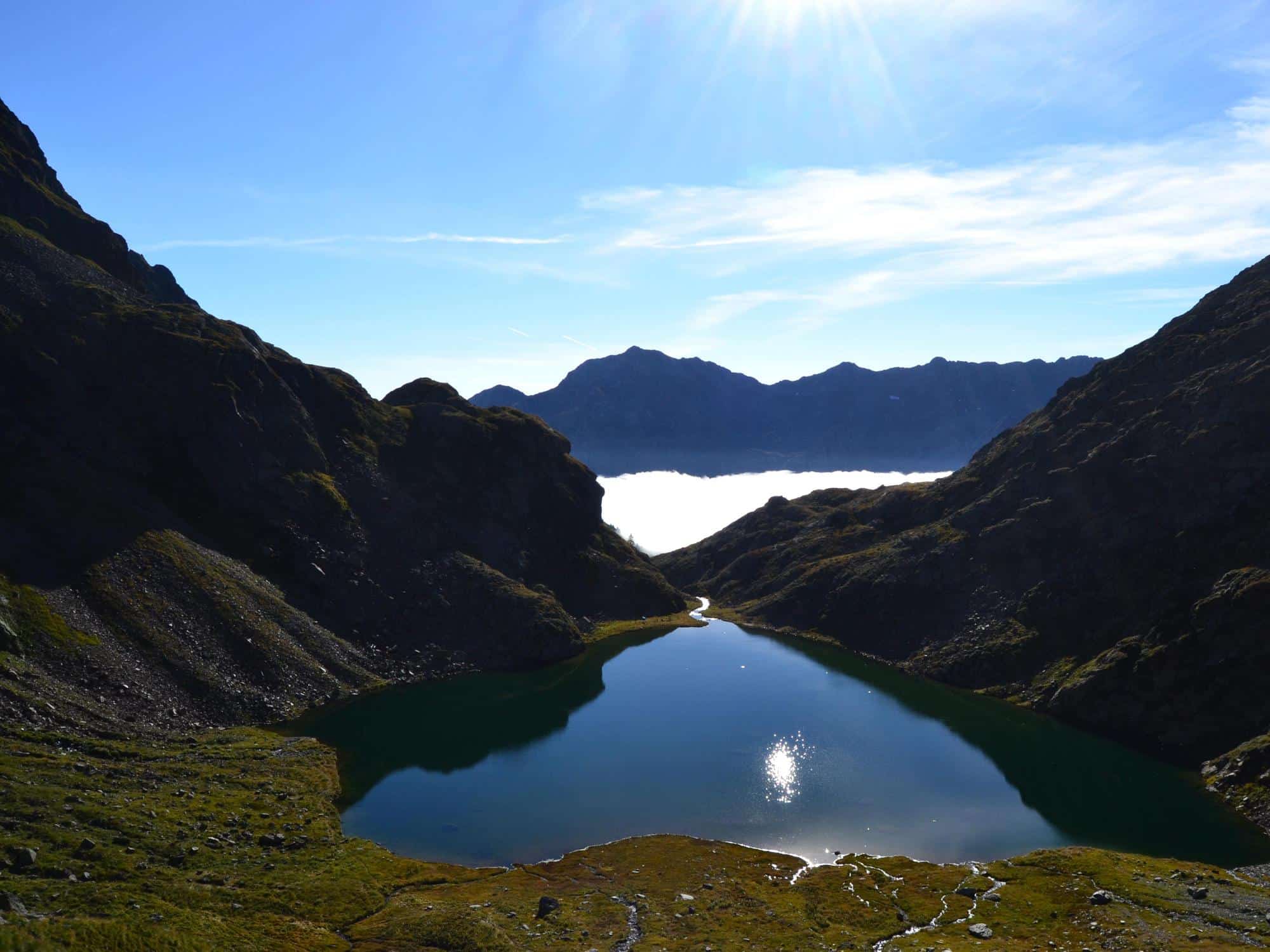
Awaiting us, half an hour from the refuge, is the majestic Lago Bianco (2332 m). Although the water is very cold, the bravest can take a dip!
The lake, insolated between the mountains, is shallow and inhabited by char. Fishing enthusiasts can expect us here practising no-kill fly-fishing, while we continue, skirting the entire lake, towards the Black Lake.
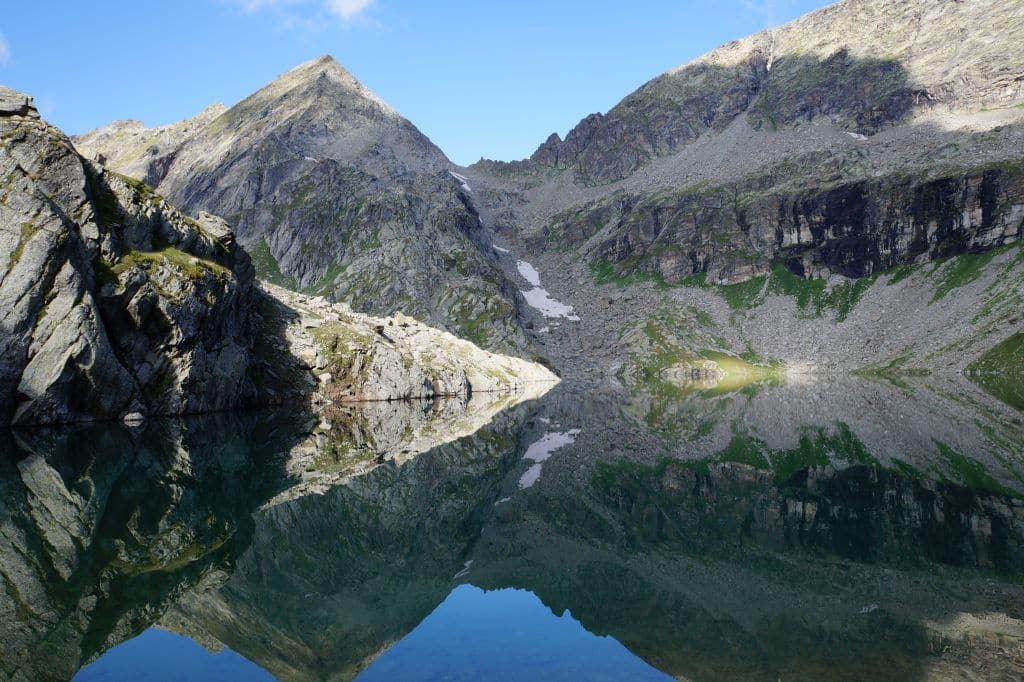
We dedicate another 1h 30' of walking time and arrive at Lake Nero (2672 m), which is very deep and inhabited by char, rainbow and a few beautiful brown trout. We will almost certainly have to tread some snow: a fantastic mountain climate and a lot of peace and quiet will welcome us.
Do you know what an ancient legend has it?
It is said that a bride lost her ring right here, at Lake Nero, and that it was later found in the fountain of the ‘Giavino’ (a spring between Riva and Alagna, opposite the petrol station).
The difficult path that experienced hikers take to get to Corno Bianco starts from Lago Nero; this path requires a great deal of attention, in fact, many mountaineers have lost their lives here. It was therefore necessary to equip the path with chains.
But we proceed no further, we have already walked 4h 30' and, above all, the polenta with sausage at the Refuge is waiting for us!
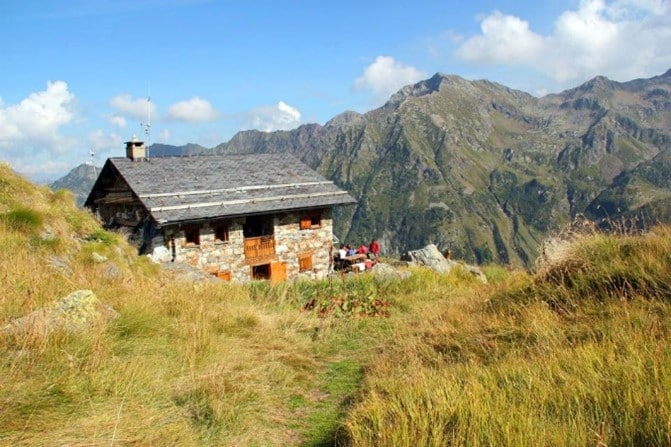
Walking on a Via defined Regia may be intimidating, but we guarantee that, although a bit tiring, it will prove to be an experience to remember.
But why is it called the Via Regia? Although it may seem hard to believe, this road has been very busy in the past. It was the connecting route between the ancient Grand Duchy of Milan (before), the Kingdom of Savoy (after) and the territories of Switzerland and France, passing through the neighbouring Valle d'Aosta.
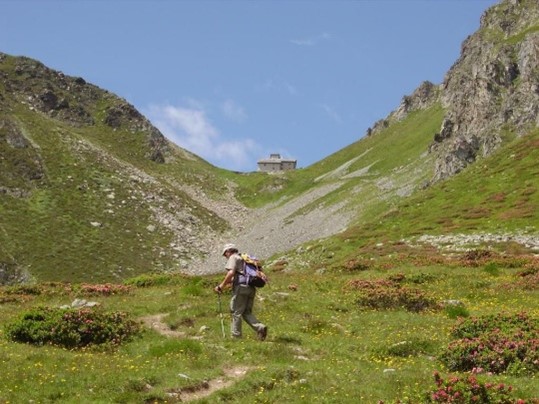
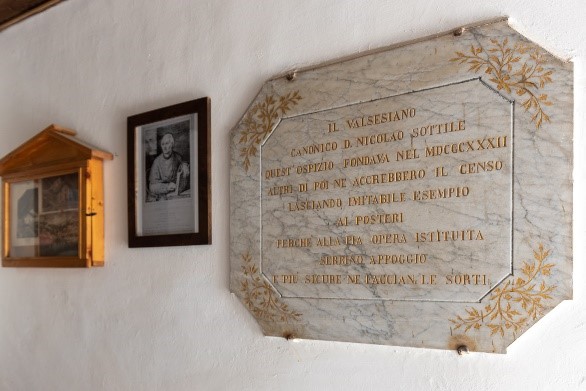
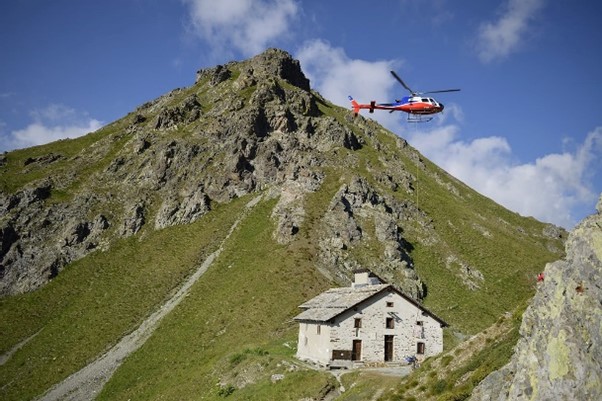
For centuries, Walser, merchants, soldiers of the Austrian and French armies and even the plague, crossed the Valdobbia Pass, which serves as the border between two enchanted valleys: the Vogna Valley and the Gressoney Valley. This continuous wandering at 2480 m, which lasted for centuries and was accompanied by difficult weather conditions, made it necessary to build a simple shelter. Canon Nicolao Sottile had a more organised structure erected at his own expense, including a Chapel to comfort body and soul.
The establishment of a Meteorological Observatory in 1871, the first in Piedmont, contributed to the increased importance of this historic building!
We leave from the hamlet of Ca d'Janzo in Val Vogna and, after passing the hamlets of Ca' Piacentino, Ca' Morca and Ca' Verno, we reach S. Antonio.
From here starts the dirty road that, on an easy and leveled route, reaches the hamlet of Peccia (1 hour). At the entrance of the hamlet we encounter an area equipped with wooden tables at the edge of the beautiful artificial lake. We continue along the road, which here becomes a path, and passing the nucleus of Walser houses, we reach the Oratory dedicated to San Grato and the Napoleonic Bridge.
Now, following the route number 201, the climb becomes steep and we understand the origin of the name of the hamlet Montata.
The path gives us pause, moves through a beautiful larch forest and arrives at the Alpe Larecchio area (1 hour). We can choose whether to rest for a while in the Alpe basin and later reach Alpe Pian del Celletto via deflection 201a, or to take the small direct route to Colle Valdobbia/ Ospizio Sottile straight away. The refuge looms on the horizon and it seems as if it will never arrive, but we persevere with determination, stand in front of the refuge and let out a big sigh.
Welcoming us with open arms is the young manager Simone, who will not let us want for anything!
We take advantage of the warm hospitality, thinking back to the old migrants who found salvation and protection within these walls.
We have reached our goal! Now we can enjoy the beautiful 360-degree view.
We mustn't forget that on 1 July, we may attend the characteristic passage of the Monte Rosa Walser Waeg race, offering warm support to the courageous athletes who will run 45 km immersed in the splendour that the mountain offers them.
On 10 th August, we are all invited to the typical lunch and Holy Mass organised by the refuge.
What the path to the Colle and the visit to the Hospice offers is an ineffable experience of pure contemplation and revelation.
... We look forward to many more adventures in the beautiful valley that surrounds us!
Do you like border areas?
Here you are on the right track!
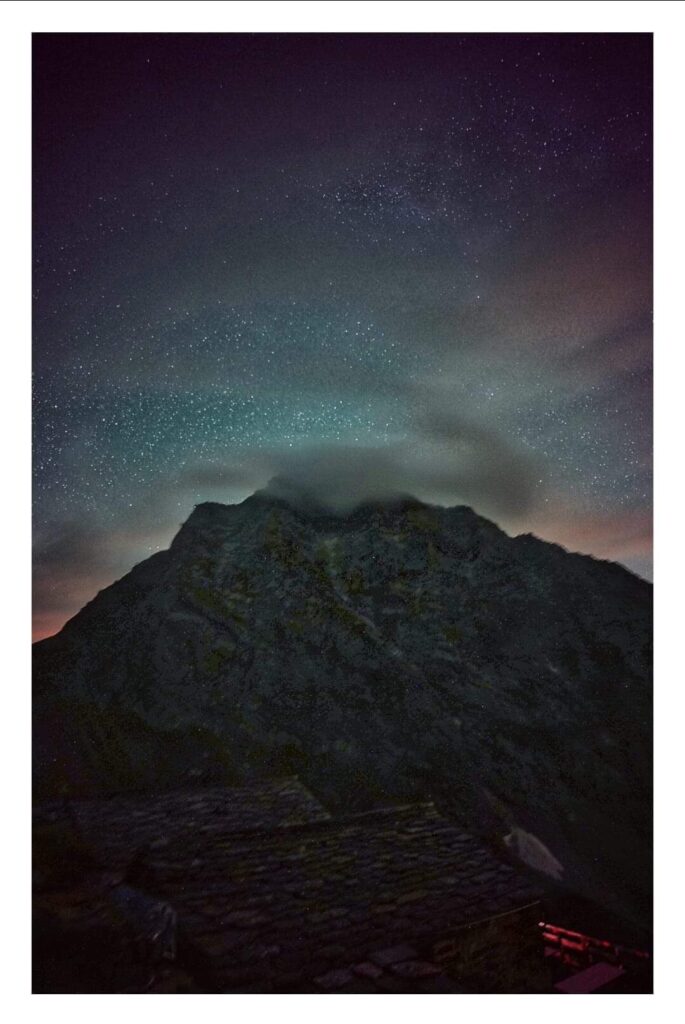
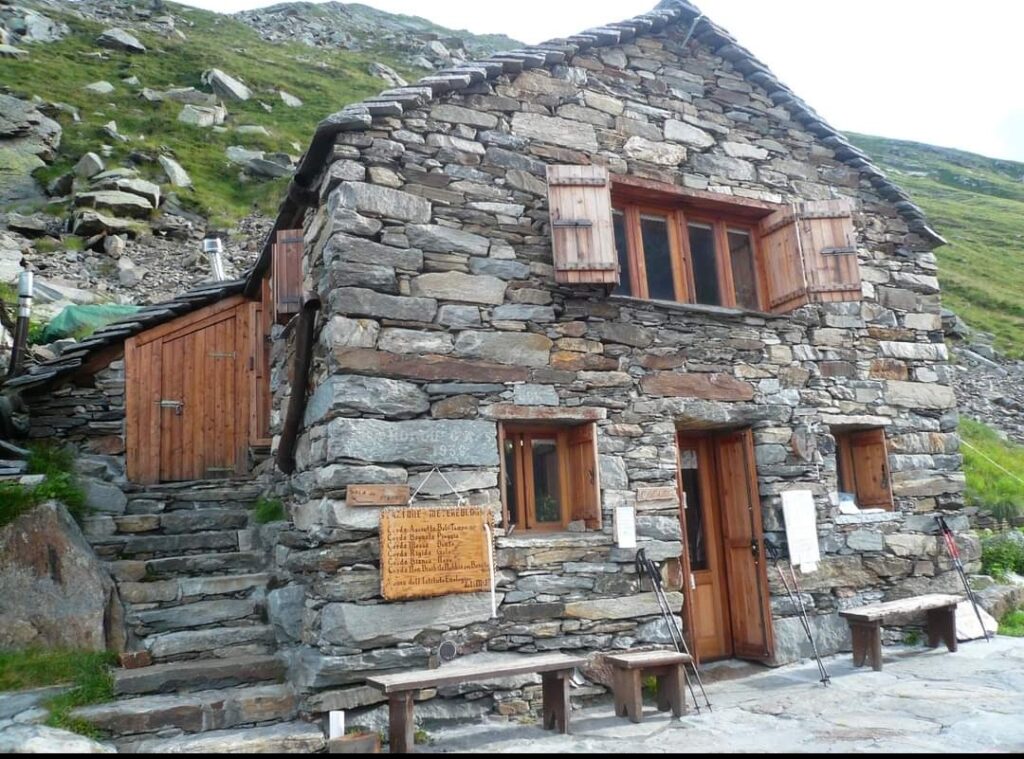
We suggest you take the route to Colle Mud and just below the Rifugio Ferioli (Ferioli Hut), following path 208 from the hamlet of Ronco.
The Walser language suggests that the term Mud means 'mute', so if it is silence you seek, set off and make way for the sounds of the soul and nature!
We take path number 208 at the foot of the hamlet of Ronco, following the orographic right of the Mud stream for the first few metres. In about 1h 30 - 2h we reach the houses of Mud di là and Mud di qua.
The alpine pasture must have been very large, judging by the number of huts present. Alas, over the years the fury of avalanches has damaged several of them.
In the Walser population, it was customary to set up mutual aid corvées in the event of a disaster; each family sent a representative to help the injured.
Unfortunately, this custom has been lost except for the cleaning of the trails.
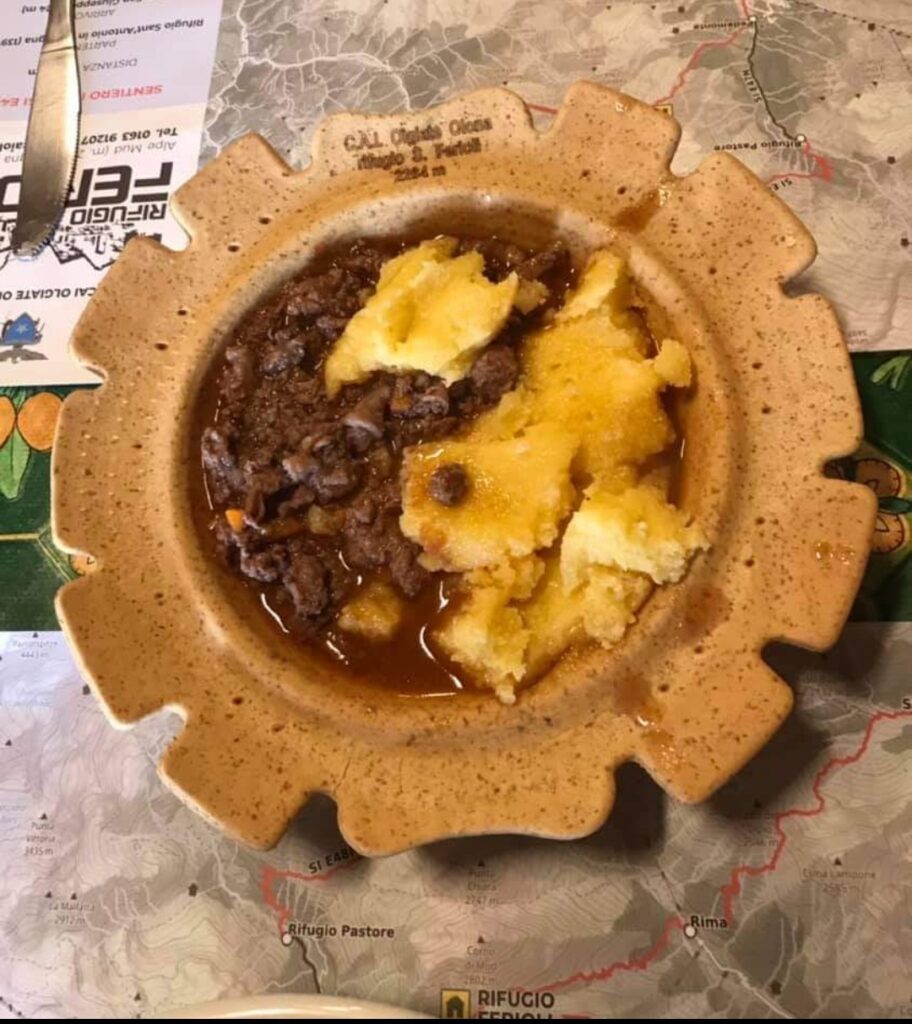
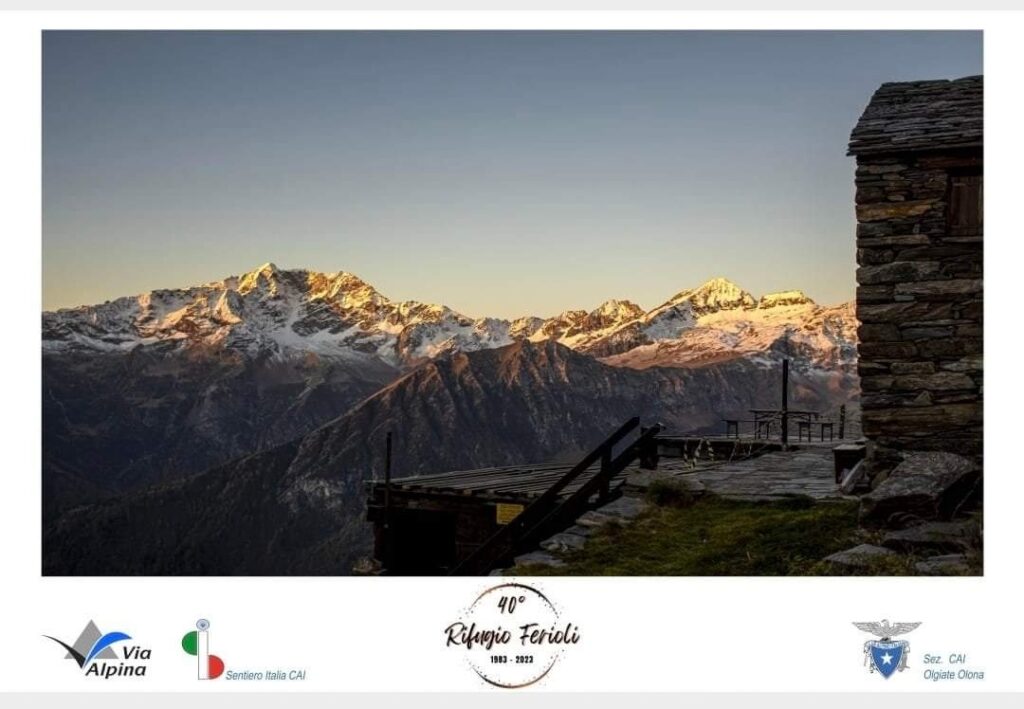
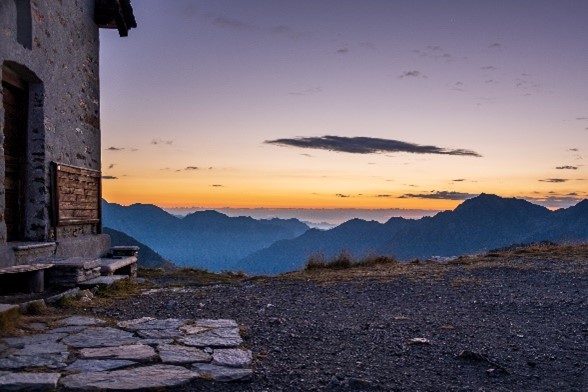
We then climb in about 1h to the Rifugio Ferioli, which is run directly by Section Members. The facility has 24 beds, a winter room and offers excellent cuisine!
The hut is included in the international circuit of the 'Via Alpina', a hiking route connecting Trieste, on the Adriatic coast, to Monaco and the Mediterranean.
The path is also part of the GTA, the Great Alpi crossing, much travelled in summer.
Fifteen minutes more and we reach the Mud Pass (2324 m)!
Here is the border beyond which you will find mountains, more mountains and more mountains! And valleys!
If you are curious to visit the nearest valley in about 1h.30 - 2h you can follow the long descent to the village of Rima San Giuseppe, a colony founded by the Walser people.
The hike is suitable for everyone, but for the more experienced, from the Pass it is possible to tackle the mountaineering route of the Tagliaferro North Ridge, one of the most beautiful ridges in the area!
But this is another story and we will tell you another time!